Drift Protocol: Guangzhou
0. Origin
Drift Protocol comes out of Uncharted Destiny and Constant Magic (UDCM), an ongoing relational archive project. UDCM is concerned with how people meet, how they alter each other, and how a relationship gets looked back on, answered and reorganised over time.
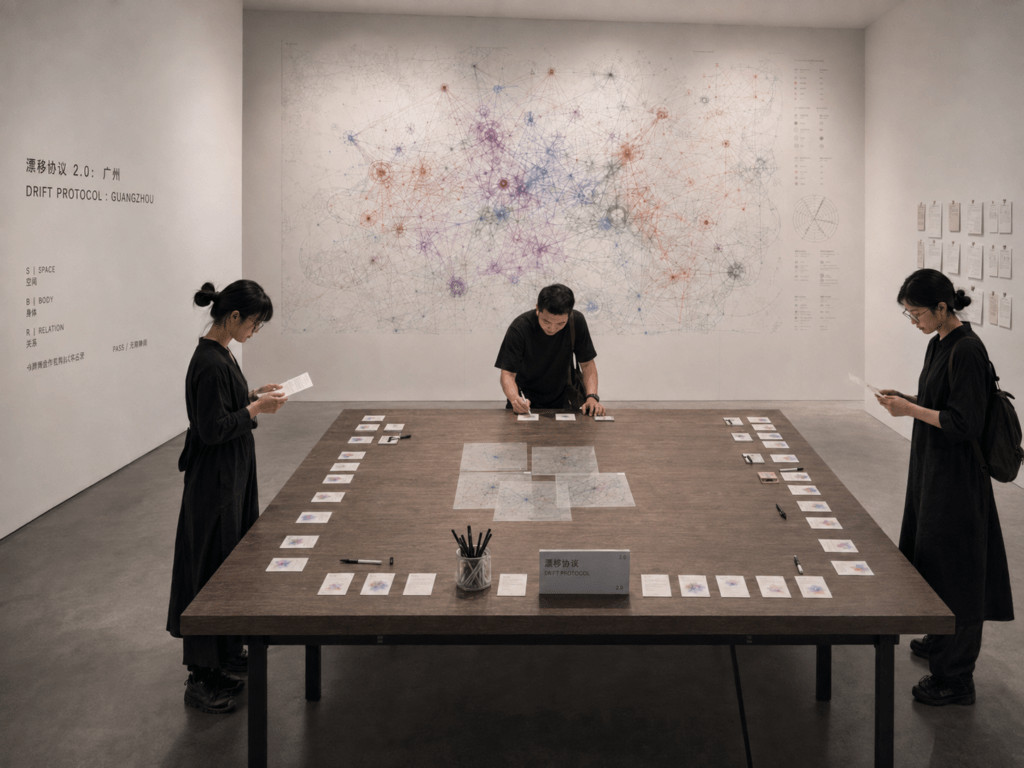
Drift Protocol extends that work from a personal network into the shared ground of a city. Using space, body and relation as prompts, participants mark routes and places they have actually lived through onto transparent layers. When the layers are overlaid, memories that had nothing to do with each other may cross, overlap or come close — and, only by consent, become a new encounter.
The protocol does not try to prove that participants once met. It is an executable memory procedure that lets strangers’ pasts make contact for the first time in the present, producing a city archive that keeps changing.
In the Chinese context it carries a specific charge. It is a bottom-up narrative instrument. The official record of a city is made of demolition notices, renamed streets and planning documents; this archive is made of six people’s legs, skin and relationships. When six strangers cross at a coordinate that no longer exists on any official map, what gets confirmed is not the city — it is that they are still here.
1. Why 2.0
Protocol 1.0 was tested in Guangzhou in August 2026: four people, including the artist, all acquainted. It failed, informatively.
Failure 1 — it felt like an exam.
1.0 split production from encounter into two blocks: seventy minutes of individual drawing and writing, then overlay at minute eighty. During those seventy minutes nothing any participant did affected anyone else. That line is exactly the line between a questionnaire and a game — in a questionnaire your answer concerns only the person asking; in a game every move you make changes everyone else’s position. The room stayed silent. It felt like conducting a street survey.
Failure 2 — points, no lines.
Every card’s main clause was recall a place, mark it with a symbol. Routes sat in subordinate clauses, hedged with if you remember and you may also. Optional actions get skipped under time pressure. Four people × four cards = sixteen isolated points scattered across a whole city, with an intersection probability near zero. Participants could sense while drawing that no payoff was coming, and the drawing collapsed back into form-filling.
Failure 3 — the archive formed in the artist’s hands.
Participants produced raw material; numbering, layering and archiving were all done by the artist. This runs against the bottom-up premise.
2.0 is not a parameter adjustment. It replaces the underlying assumption that production and encounter can be separated.
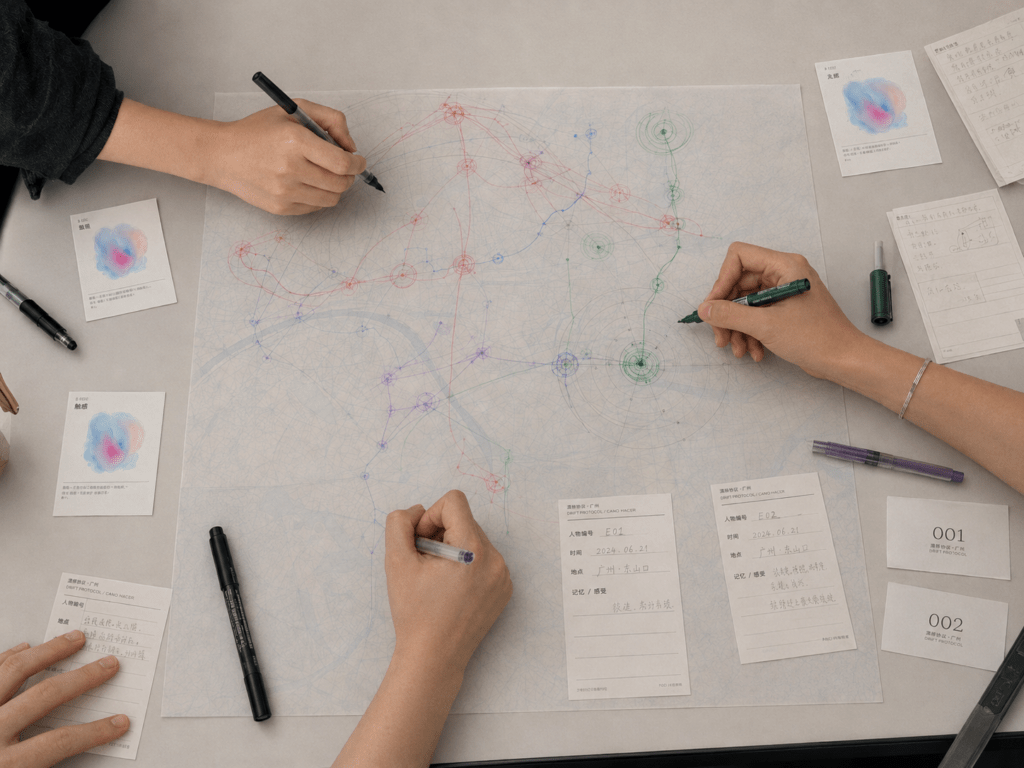
2. Six Structural Changes
① Overlay after every single card.
Encounter is no longer a finale. It runs continuously. The first intersection appears at minute ten, not minute eighty.
② Inverted card syntax: draw the line first, then place the mark on it.
Every card’s main clause is now a route; the symbol has been demoted to a position along that route. All optional clauses deleted. Line length determines intersection density, and intersection density determines whether the session works at all.
③ Public cards bookend the session.
Two cards that concern only today, not memory, drawn by six hands on one shared sheet. The opening card converges (how you got here today); the closing card diverges (where you go tonight). Crossings appear on the paper within the first minute — no one has to be told that lines will cross, because it has already happened.
④ PASS is no longer an exit; it becomes fiction.
Say it aloud, stay on the same card, and replace real memory with invention. No one is excluded from a card, and no one is forced to surrender a memory they cannot speak. Declared fiction is not contamination — it is a different kind of data.
⑤ Claiming replaces collective adjudication.
Intersections are not decided by group vote. Anyone who sees another’s trace near their own line reaches in and circles it, in their own colour. Single-sided claims are archived too — they record I saw you, and you did not turn around.
⑥ The archive is written by participants; indexed, not transcribed; six copies.
Every mark on the E-layer belongs to a participant. The artist writes nothing on it. The final Encounter Record carries index entries only, is printed on site, and each person takes one home.
3. Setup
Participants Six, all strangers. The artist does not play; they read the cards aloud and keep the record.
Duration Roughly 165 minutes.
Colour Six colours distributed at random, not chosen. That colour is the participant’s identity in the archive.
Number Each person is assigned No.01–No.06. The archive contains no names.
Symbols
Category | Sym | Meaning |
S | SPACE | ○ | Space: routes walked, places stayed in |
B | BODY | ✕ | Body: what the body actually registered along that route |
R | RELATION | ∞ | Relation: the human connection that occurred in that place |
Line types
Line | Meaning |
Solid | Walked |
Dotted . . . . . . | Not walked. Invented |
Both line types carry symbols, under identical rules. Line type marks real versus invented; the symbol marks meaning. Two systems, one job each.
Base map
All POI labels removed. River, arterial skeleton and metro lines only, plus one or two anchors that cannot be stripped. Printed place names pull private geography back toward commercial landmarks, and labelling is itself part of the official narrative.
Frame: Guangzhou Station and Guangzhou East Station in the north, University Town and northern Panyu in the south, Liwan in the west, western Huangpu in the east. This contains University Town, Sun Yat-sen University south campus, Shipai–Gangding, Kecun–Chigang, Beijing Road, Shamian, and both railway stations — for anyone not born in Guangzhou, the stations are where their line through the city begins, which makes them almost free intersections. Southern Panyu, Nansha, eastern Huangpu and Huadu are excluded; the trade-off prioritises intersection density.
Lines may run off the paper. The map’s edge is an administrative and printing artefact. Crossing it is the one moment the sheet itself becomes visible. State the rule plainly: if the paper runs out, draw onto the table.
4. Materials
- Eight film sheets: six personal (participant number in the corner) + one E-layer + one public sheet
- One white backing sheet with a registration frame at the four corners
- A corner notch or punched hole on every film sheet, aligned to the backing
- Six fine oil-based pens, one colour each. Claiming uses your own pen; there is no separate marker
- The full S/B/R deck (18 cards) + two public cards
- A pen for writing card backs
- A portable photo printer for the six Encounter Records
- Documentation: white backing, light from below or from the side. Top light reflects off film
Skip the registration marks and the overlay is fake — five millimetres of drift turns every intersection into noise.
Test before the session: whether dotted lines are still legible through six stacked layers. Short dashes from a fine oil-based pen can be confused with the broken, shaky lines produced by B03. If they cannot be read, switch to a doubled line or widen the dot spacing.
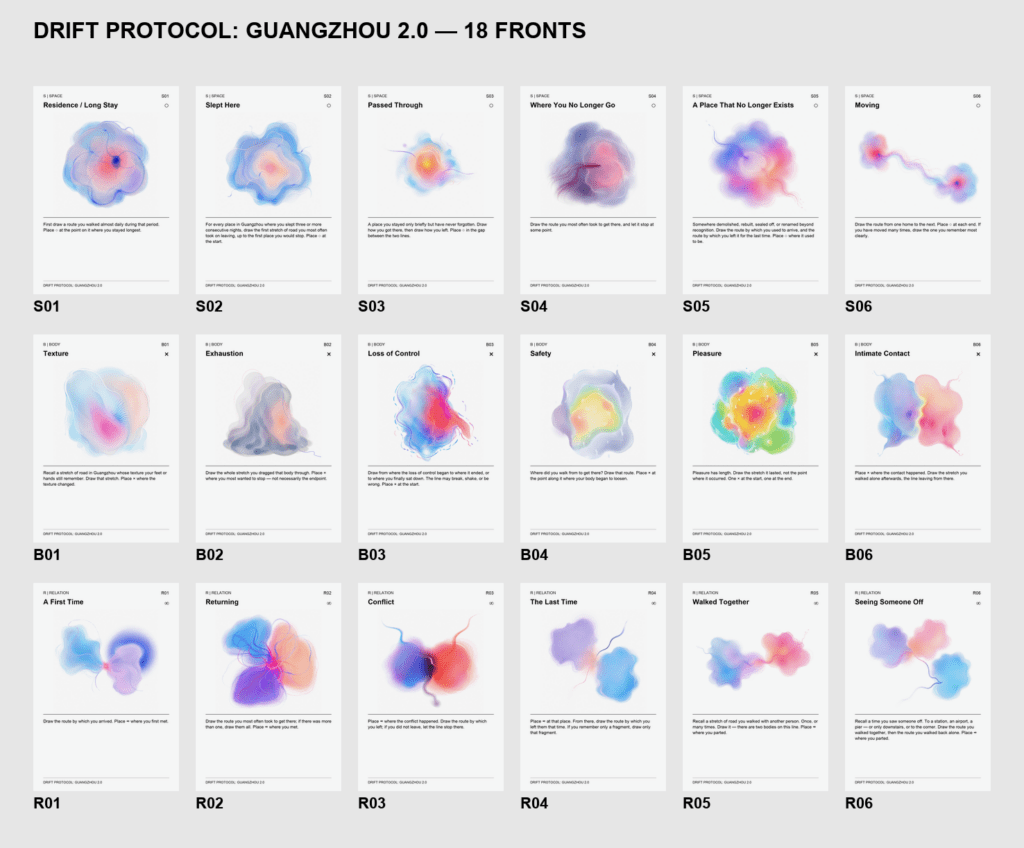
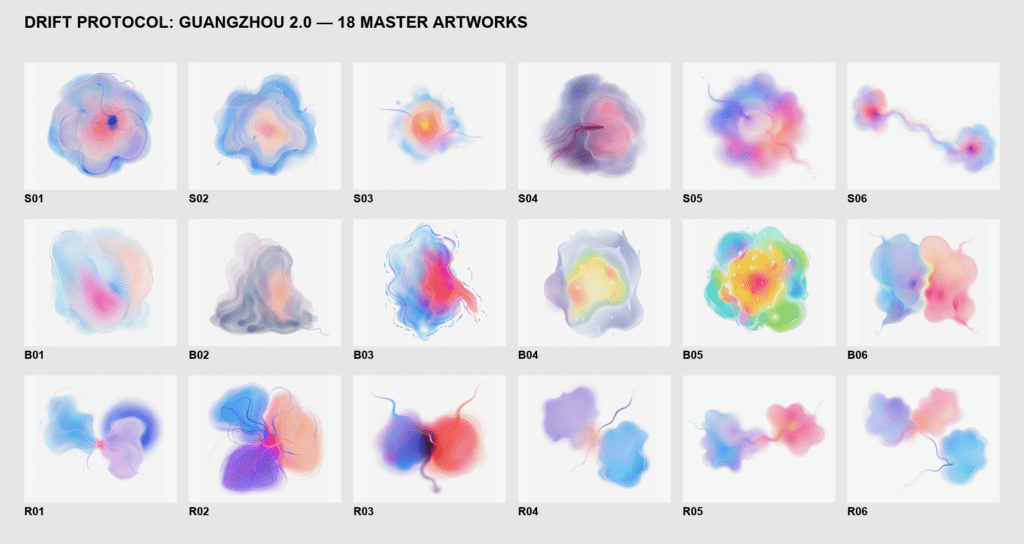
5. The Cards
Unified syntax: draw the line first, then place the mark on it. All instructions are imperative. Nothing is optional.
S | SPACE ○
S01 Residence / Long Stay
First draw a route you walked almost daily during that period. Place ○ at the point on it where you stayed longest.
Card back — Back then, why were you always in these places?
S02 Slept Here
For every place in Guangzhou where you slept three or more consecutive nights, draw the first stretch of road you most often took on leaving, up to the first place you would stop. Place ○ at the start.
Card back — What do you most remember about the surroundings while you lived there?
S03 Passed Through
A place you stayed only briefly but have never forgotten. Draw how you got there, then draw how you left. Place ○ in the gap between the two lines.
Card back — What is it you actually remember?
S04 Where You No Longer Go
Draw the route you most often took to get there, and let it stop at some point.
Card back — Do you remember when you stopped going?
S05 A Place That No Longer Exists
Somewhere demolished, rebuilt, sealed off, or renamed beyond recognition. Draw the route by which you used to arrive, and the route by which you left it for the last time. Place ○ where it used to be.
Card back — When was the last time you went there?
S06 Moving
Draw the route from one home to the next. Place ○ at each end. If you have moved many times, draw the one you remember most clearly.
Card back — Was that move your own decision?
S04 now holds a single solid line that stops. The stopping is the entire content of the card; no comparison line is needed to explain it.
S05 has the highest intersection probability in the deck. Demolition is a collective event; six strangers landing on the same coordinate is far likelier here than at Shamian. It also carries the heaviest political weight — consent must be re-confirmed separately before archiving.
S06 produces the longest single line in the deck: one that crosses the city with a ○ at each end. Its crossings occur mid-route rather than at endpoints. Two people having both used Guangzhou Station is not surprising; two moving-day routes crossing on Guangzhou Avenue is.
B | BODY ✕
B01 Texture
Recall a stretch of road in Guangzhou whose texture your feet or hands still remember. Draw that stretch. Place ✕ where the texture changed.
Card back — What texture does your body remember?
B02 Exhaustion
Draw the whole stretch you dragged that body through. Place ✕ where you most wanted to stop — not necessarily the endpoint.
Card back — That time, why were you so tired?
B03 Loss of Control
Draw from where the loss of control began to where it ended, or to where you finally sat down. The line may break, shake, or be wrong. Place ✕ at the start.
Card back — What happened to your body? You do not need to explain why.
B04 Safety
Where did you walk from to get there? Draw that route. Place ✕ at the point along it where your body began to loosen.
Card back — Why does your body relax here? “I don’t know” is a valid answer.
B05 Pleasure
Pleasure has length. Draw the stretch it lasted, not the point where it occurred. One ✕ at the start, one at the end.
Card back — What was your body happy about?
B06 Intimate Contact
Place ✕ where the contact happened. Draw the stretch you walked alone afterwards, the line leaving from there.
Card back — Why did your body remember this contact? You do not need to say who the other person was.
R | RELATION ∞
R01 A First Time
Draw the route by which you arrived. Place ∞ where you first met.
Card back — Back at that first meeting, did you know this person would become important?
R02 Returning
Draw the route you most often took to get there; if there was more than one, draw them all. Place ∞ where you met.
Card back — Back then, what kept bringing you here?
R03 Conflict
Place ∞ where the conflict happened. Draw the route by which you left; if you did not leave, let the line stop there.
Card back — Did the relationship change after this? You do not need to say who it was with.
R04 The Last Time
Place ∞ at that place. From there, draw the route by which you left them that time. If you remember only a fragment, draw only that fragment.
Card back — Did you know at the time that it was the last?
R05 Walked Together
Recall a stretch of road you walked with another person. Once, or many times. Draw it — there are two bodies on this line. Place ∞ where you parted.
Card back — Have you walked that road alone since?
R06 Seeing Someone Off
Recall a time you saw someone off. To a station, an airport, a pier — or only downstairs, or to the corner. Draw the route you walked together, then the route you walked back alone. Place ∞ where you parted.
Card back — Why did you stop where you stopped?
R05 is the only card in the deck whose line was, by definition, produced by two people. When two participants’ traces overlap on this card, the question did we actually meet reaches its sharpest form.
R06 produces a shared outbound line and a solitary return, usually terminating at stations and piers — among the densest intersection coordinates in the city.
P | PUBLIC Six hands, one sheet
P01 How you got here today (opening · convergent)
All six lines converge on a single endpoint: this table, now.
P02 Where you go tonight (closing · divergent)
Starting from here. Six lines separate outward.
Public cards allow no PASS and no dotted lines. They concern today, not memory. Everyone has an answer.
Card back
Field | Entry |
No. | __________ Round __________ 〔fiction〕 □ |
Time | __________________________________ |
Place | __________________________________ |
Memory / Sensation | __________________________________ |
Time and place may be vague: around 2017, university years, not sure, somewhere in Haizhu.
- “Round” lets the archive be read horizontally — one card, six responses
- The “fiction” box is ticked only when the card was drawn as a dotted line. A dotted-line card back may be left blank
6. Session Flow
Eight cards per person: six individual, two public. All six participants are always holding the same card.
Suggested card order
Round 1 S01 Residence → B02 Exhaustion → R02 Returning
Round 2 S05 A Place That No Longer Exists → B06 Intimate Contact → R04 The Last Time
Principle: S lays the skeleton → B tests the water → the highest-intersection card sits mid-session → R closes. The most fragile card belongs neither first nor last — no one is ready at the first card, and there is no time to catch what the last one opens.
The twelve unused cards
A session uses six. The remaining twelve are not spares — they are the variable between sessions. A second session might run S02 → B04 → R05 / S06 → B01 → R03. The ordering principle stays; the specific cards change. Three sessions cycle through all eighteen, and each session acquires its own character.
7. Mechanics
7.1 Drawing a card
One card for the whole table, read aloud by the reader. A voice enters the room, and drawing becomes a shared event.
7.2 PASS and the dotted line
PASS is not an exit. It converts the card from real memory to invention.
Procedure
- Say the fixed sentence: “I pass this one. I’ll draw one I never walked.”
- Stay on the same card — the prompt does not change
- Draw a dotted line instead of a solid one
- Place symbols as normal, under the same rules as a solid line
- The card back may be written or left blank. If written, tick 〔fiction〕 in the corner
Allowance: once per round, twice per session. No PASS on public cards.
Why it is built this way
Declared fiction is not contamination. A line that announces this is not something I walked is an honest entry in the archive. The real risk is an unmarked false line mixed in among true ones — and under this mechanic that cannot happen.
The content of the invention is itself data. What a person invents on the Intimate Contact card — which district, how long, where the line leaves from — is not random in any of its choices. For a project working through psychoanalytic method, invention is not missing data; it is a second kind of data, and one almost impossible to obtain by asking directly.
It makes a new kind of encounter possible. Six people hold the same card; five solid lines and one dotted. If the dotted line crosses someone’s solid line, the exchange runs: one says I had contact here I cannot forget, the other says I have never walked here. Same coordinate, same prompt, one with and one without.
A dotted × dotted crossing is not a joke. Two people who could not answer the same card, their two invented routes meeting — that is the rarest point on the E-layer. They share no past. They share the same unsayable place.
The archive can be read horizontally. Because the whole table always holds the same card, the archive can for the first time be read card-wise: on B06, six people produced three solid lines, two dotted, one blank. Which card is hardest to answer becomes measurable. After three sessions, that distribution tells you which cards need rewriting.
The allowance sits at one third. Two passes means at most a third of a person’s map is invented, and the archive remains grounded in real experience. Loosen it to half and the horizontal statistic collapses — what it measures is no longer this card is hard but nobody feels like drawing. The once-per-round cap exists so that no one has to calculate across rounds: Round 2 is three heavy cards, and a person who spent both passes early would be left without an option exactly where they most need one — and would have been calculating rather than remembering from the very first card.
7.3 The four opening lines
The reader must deliver these during the rules briefing, in this order:
One. A card usually corresponds to more than one memory. If the first one that surfaces is too heavy, keep looking further down.
Two. Any card may be passed. When you pass, you do not leave the card — you draw one you never walked.
Three. The invention can be anything, including the most boring thing you can think of.
Four. No one asks why. Nobody.
The order matters. There are other options comes before if there really is nothing, invent. Reversed, the dotted line becomes the default exit.
The third line is the safety valve of the whole mechanic. Someone passes B06 because there is a wound there. If they believe invention still requires a presentable story, they have no exit at all. Only by stating plainly that invention carries no truth requirement does the exit actually stay open.
The fourth line is enforced live by the reader. When someone presses for a reason, cut it off.
7.4 Overlay and claiming
After every card:
- The six personal sheets are stacked on the white backing and registered
- The E-layer comes onto the table and goes on top (it sits at the table’s edge all session, a sheet waiting to be written on)
- Sixty seconds of silence. No explaining, no talking
- Claiming: anyone who sees another’s trace near their own line reaches in, circles it on the E-layer in their own colour, and says this is my line, I’m circling it
- Whoever circles first writes the number (E01, E02…), also in their own colour
- The other person may nest a circle outside it — or not respond
- The E-layer comes off and returns to the table’s edge
Scale: “about one block.” Not fixed; the rest is left to the room.
Dotted lines rank equally with solid ones. They can be claimed and enter the E-layer without distinction.
Concentric rings = number of responses
The inner ring saw it first, the outer ring second. The colour of the number records who saw it first. A third claimant makes three concentric rings.
This is the same grammar as the concentric circles in S02: one records the thickness of time spent on a private layer, the other the thickness of being seen on a public one.
Single-sided claims are archived. A point circled by one person and left unanswered by the other is one of the most valuable things this protocol produces. It records I saw you, and you did not turn around. Since the number of colours is itself the number of responses, no additional symbol is needed — one look is enough.
“I want to speak about this.” A claimant may draw a short dash beside the number. No dash means I circled it, but I may not want to open it. The choice belongs to the claimant, not to the reader’s ordering.
7.5 Exchange
Work back from the most recent point. Dashed entries first.
Round 2 points are discussed first, while they are still warm; the earliest points come last, by which time people have warmed up and can actually go back to a crossing from ninety minutes ago. Run it in chronological order instead and the opening point gets processed in the coldest state of the session.
Exchanges involving a dotted line are asymmetrical. One person turns over a card back; the other says only I have never walked here. If the dotted card back was written, the exchange can be symmetrical.
Only once the exchange has happened does an Intersection in space become an Encounter:
Intersection + Exchange = Encounter
Circles that produced no exchange stay on the E-layer. They record proximity, not encounter.
7.6 The Encounter Record
Index only. Never transcript.
Claimant | Second claimant | Place | |
E01 | No.03 / A Place That No Longer Exists | No.05 / Conflict | Liede |
E02 | No.01 / Exhaustion | No.02 / Returning | Kecun |
E03 | No.04 / Safety | 〔single〕 | Shamian |
E04 | No.02 / Intimate Contact | No.06 / Intimate Contact 〔fiction〕 | Changgang |
What was said belongs to whoever said it. What was written is already on the card backs. This sheet records one thing only: which two pasts were placed side by side today.
- 〔single〕 = claimed by one, unanswered by the other
- 〔fiction〕 = at least one side is a dotted line
- Before it is finalised, each person may strike their own line
- Printed on site, six copies, one each
- One sheet, one date, six numbers, a string of coordinates — no author, six copies
7.7 The public sheet
Both public cards share one film sheet. Its number is the date.
Six lines converge on the table at the opening; six diverge from it at the close, crossing at a single coordinate. This sheet needs no E-number — the entire sheet is one encounter point.
8. Timing
Time | Content |
0–15 | Opening. Colours and participant numbers distributed at random. Symbols, line types, PASS and the dotted line, claiming, archiving and withdrawal. The four opening lines |
15–25 | Public card P01 (convergent). The first intersection appears here |
25–61 | Round 1: S · B · R, twelve minutes each (5 draw / 2 card back / 5 overlay, silence, claim) |
61–97 | Round 2: S · B · R |
97–135 | Exchange, working back from the most recent point |
135–145 | Public card P02 (divergent) |
145–165 | Documentation, withdrawal check, six records printed, close |
165 minutes leaves no slack. If live testing shows fourteen minutes per card, cut Round 1 to S–B only (drop R02, which partly overlaps R04 in function).
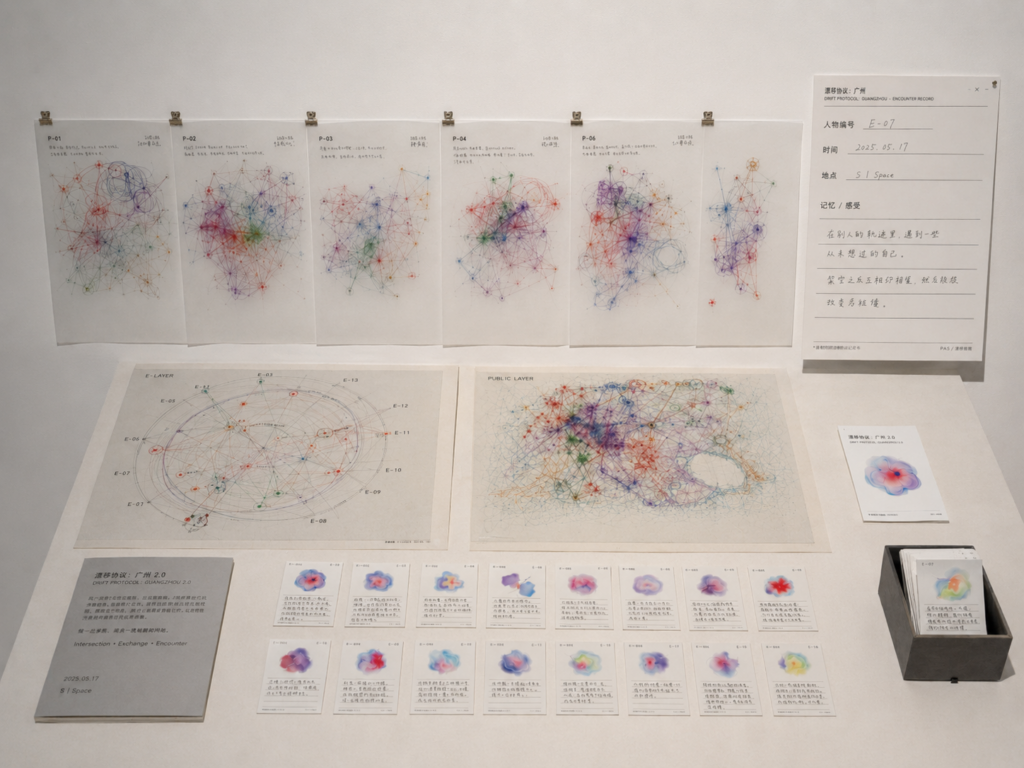
9. What One Session Produces
- Six personal film sheets — numbered in the corner, viewable singly, recombinable in any order. Solid and dotted lines coexist
- One E-layer — numbers, concentric rings, single-sided claims, entirely in participants’ handwriting
- One public sheet — numbered with the date, convergence and divergence crossing at one point
- Up to 36 handwritten card backs (6 people × 6 cards). Dotted-line backs may be blank; withdrawn cards excepted
- One Encounter Record × six copies
Each session stands alone. A second group never sees the first group’s sheets, and E-numbering restarts at E01. Filenames carry session and date: the E01 of session three and the E01 of session one are two different things.
Database structure: person → card → place → memory → spatial overlap → present-tense encounter. Map = spatial index. Card = time + place + body/relation. E-layer = today.
Because the whole table always holds the same card, the archive gains a vertical dimension: the distribution of solid / dotted / blank on a single card, across six people and across sessions. It becomes a legible record of which memories are hardest to speak.
10. Ethics
- Card backs are private by default
- Any card may be passed, unexplained and unquestioned. PASS is not an exit but a switch to the dotted line. Allowance: once per round, twice per session
- Invention carries no truth requirement. It can be anything, including the most boring thing possible
- Exchange occurs only with mutual consent. Single-sided claims are archived but do not constitute exchange
- A participant may withhold any card. Once submitted, it enters the project archive
- Before the Encounter Record is finalised, each person may strike their own line
- No names in the archive — only participant numbers and colours
- S05 carries higher political sensitivity with a group of strangers. The opening statement once submitted, it enters the archive becomes a heavy sentence on this card. Consent must be re-confirmed separately before archiving
The cap is on the deck and on the ratio, not on the right to refuse. A person with nowhere to retreat does not tell the truth — they draw a harmless line and write a safe sentence. That false line enters the archive, can be claimed, and can trigger an exchange, exactly like a true one. For an archive whose only material is lived experience, that is far worse than a blank. The entire point of the dotted line is to give I cannot say this an honest form.
11. Status
- Protocol 1.0 — tested in Guangzhou, August 2026. Four people including the artist, all acquainted. Diagnosis in Section 1
- Protocol 2.0 — this document. A structural rewrite. Not yet run
- Next — recruit six strangers and run one full session
The first thing 2.0 must verify: when the first claim happens, and whether it happens spontaneously. If someone reaches in at the first overlay, the protocol holds. If Round 1 ends with no one claiming, the fault is in the map frame or in the cards’ capacity to induce long routes — go back and change those, not the flow.
The second: the dotted line — whether anyone uses it, on which cards, and whether it stays legible through six stacked layers.
Uncharted Destiny and Constant Magic
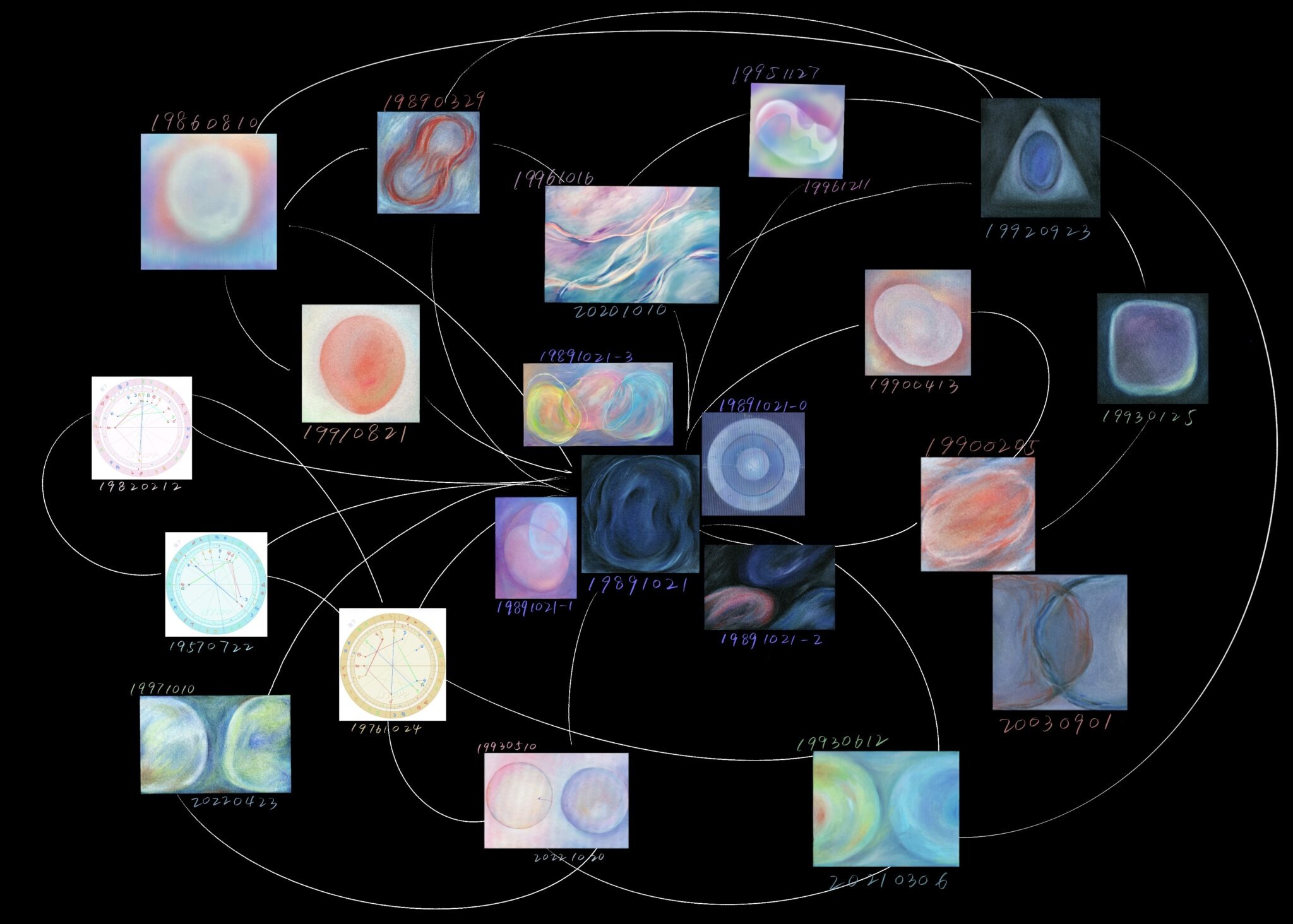
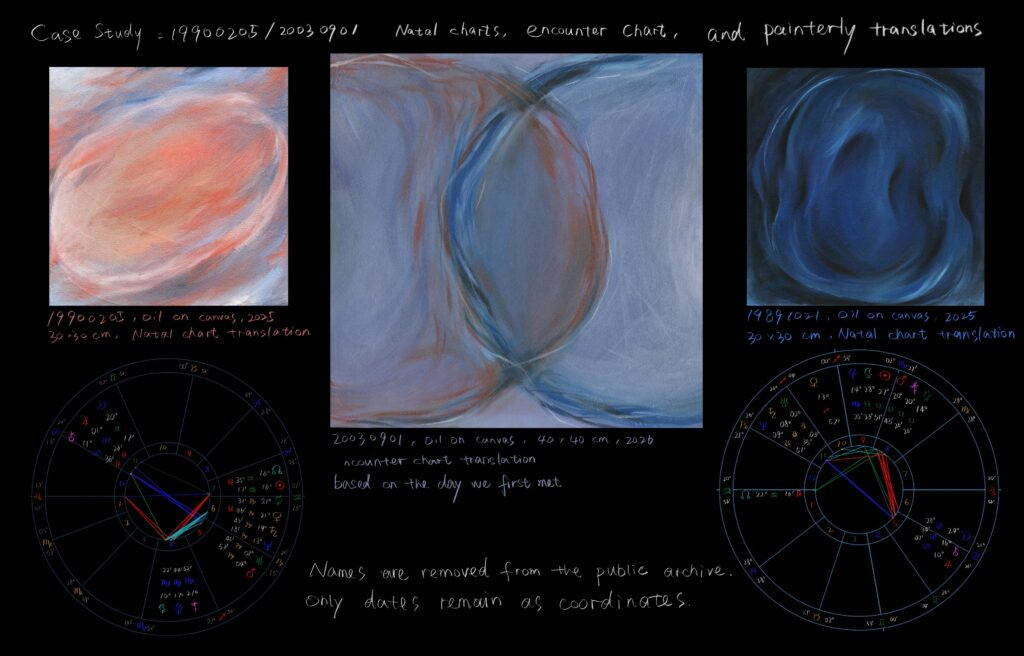
Uncharted Destiny and Constant Magic is an ongoing visual genealogical investigation.
I position myself as a fixed cosmic coordinate, using my birth date, 19891021, as the originpoint. From there I trace outward to those who have produced lasting disturbance in my life: family members, partners, childhood friends, and the psychoanalysts and project relations I encountered through An Individual as Society.
In this project, I use birth dates, moments of encounter, relationship astrology charts, painting, and archival numbering systems to construct a relational cartography of my own.
Individual natal charts are transformed into single circular paintings; synastry charts become overlapping structures between two or more subjects.
The works are titled to eliminate lyricism as far as possible, retaining only dates and numbers: birthdays, dates of encounter, family indices, or the moment a particular relationship began to disturb me.
They resemble astrological charts, but also criminal investigation boards, family genealogies, psychoanalytic notes, or some archive of fate that resists full decipherment.
I do not treat astrology as an answer, nor do I attempt to prove whether fate is real.
For me, astrology functions instead as a temporary visual language: it allows me to convert things that cannot be directly described—the pull within intimate relationships, the repetition within family structures, the body’s memory of others, the long-term consequences of certain encounters—into image systems that can be viewed, arranged, and compared.
This project extends the concerns I developed in Sumei and An Individual as Society around family, psychoanalysis, subject formation, and social relation.
But in Uncharted Destiny and Constant Magic, I am no longer only asking “how have I been shaped by others.” I have begun building a more active relational archive—attempting to see how these people form orbits around me, and how, at different moments, they have altered my position, my language, my desire, and my self-understanding.
“Uncharted destiny” points to those encounters I cannot control, yet which continue to change me.
“Constant magic” points to a recurring method of working: when lived experience cannot be held by ordinary narrative, I convert it into charts, numbers, paintings, astrological structures.
For me, magic is not an escape from reality, but a method of reorganizing it.
《未知的命运和恒定的魔法》是一项持续进行中的视觉谱系调查。我将自己设定为一个既定的宇宙坐标,以出生日期 19891021 作为原点,向外追踪那些在我的生命中产生过持续扰动的人:家人、伴侣、童年朋友,以及在《一个人的社会》中与我相遇的精神分析师和项目关系。
在这个项目中,我使用出生日期、相遇时刻、关系星盘、绘画和档案式编号,去建立一套属于我自己的关系图谱。个人盘被转化为单一的圆形绘画,合盘则成为两个或多个主体之间的重叠结构。作品的命名尽量去除抒情性,只保留日期和编号:生日、相遇日、家族索引,或者某一次关系开始扰动我的时间。它们看起来像占星图,也像犯罪调查图、家族谱系图、精神分析笔记,或者某种无法被完全破译的命运档案。
我并不把占星视为答案,也不试图证明命运是否真实。对我而言,占星更像一种临时的视觉语言:它允许我把那些无法直接描述的东西——亲密关系中的牵引、家族结构中的重复、身体对他人的记忆、某些相遇带来的长期后果——转化为可以被观看、排列和比较的图像系统。
这个项目延续了我在《苏梅》和《一个人的社会》中对家族、精神分析、主体生成与社会关系的关注。但在《未知的命运和恒定的魔法》中,我不再只是追问“我如何被他人塑造”,而是开始建立一套更主动的关系档案:我试图看见这些人如何围绕我形成轨道,又如何在不同时间改变我的位置、语言、欲望和自我理解。
“未知的命运”指向那些我无法掌控、却不断改变我的相遇;
“恒定的魔法”则指向一种反复出现的工作方式:当现实经验无法被普通叙事容纳时,我会把它转化为图谱、编号、绘画、星盘和结构。对我来说,魔法并不是逃离现实,而是一种重新组织现实的方法。
At the beginning of the project, driven by curiosity about my schizophrenic grandmother and romanticized imaginations of her madness, I attempted to analyze her mental structure after her descent into madness and how she became that way. In the process of analyzing my grandmother, I discovered many similarities between us. Our lifelines seemed tightly intertwined. I never knew the rational version of her; my childhood was spent with her in her madness. I felt love, but I didn’t know where this love came from. In her, I saw myself, my mother, and the future of my relationship with my mother. All of this filled me with curiosity, compelling me to keep questioning.
Carrying these questions, I embarked on the project. However, as the analysis progressed, my questions gave rise to even more questions. While delving into my grandmother’s family history, these inquiries gradually evolved into a curiosity about myself—how my present self was formed, why my visual works take on their current form, and how, in my unconscious state, I was able to create such coherent and orderly series. This led me to explore my personal history. Over the course of more than a year of conversations, we indexed and analyzed my childhood, adolescence, and several critical stages that later triggered the collapse of my mental state. Through dialogues centered on my personal choices and my family of origin, my long-standing confusions were untangled into fine threads of clues, some of which gradually surfaced.
在项目的初始,抱着我精神分裂的外婆的好奇,抱着对她的癫狂的各种浪漫化的想象,试图分析癫狂后的她的精神架构和她如何变成这个样子,在分析外婆的过程中,我发现自己与外婆的诸多相似,我们的生命线好像紧紧地交织在一起,我与理智的她素不相识,我的童年与疯癫的她一同度过,我感受到爱,但却不知道这个爱从何而来,我在她身上看到我,看到我的妈妈,看到我与妈妈的未来,这一切让我充满好奇,想要不断的追问下去。
带着诸多疑问,我开始进入这个项目,但是随着分析的进行,我的疑问生长出了更多的疑问,在追问外婆的家族史的过程中,这些追问渐渐发展成对自己的好奇,对现在的自我是如何形成的、我的视觉作品为何呈现此种面貌,在我无意识的状态下,为何能形成如此连贯、有秩序的系列的好奇,展开了对自己个人史的探索。在长达一年多的会谈里,我们索引分析了我的童年、青少年以及后来引发我精神状态崩塌的几个重要阶段,通过围绕我自己的个人选择和我原生家庭的对话整理后,我对我自己长期的疑惑被梳理成一条一条细丝般的线索,有一些慢慢浮出了水面。
“Sumei” was the name of my maternal grandmother, born in 1928 and departed in 2010. Owing to a taciturn disposition among the senior members of my family, the details surrounding her remained elusive until the occasion of her cremation, revealing to me for the first time the veritable constituting her true name.
What prompts me to delve deeper into my grandmother’s life?
In the intersection of my life with my grandmother, I once felt a void in not knowing her lucid self. However, as I embarked on the extensive journey of exploring our family history since 2022, conducting interviews with those who knew her in clarity, tracing her footsteps, and discovering the fragments she left behind on this earth, I realized that conversing with her directly was unnecessary; I had already known her. Be it in her lucidity or madness, she wholeheartedly provided nurturing love and protection to our family.
I aspire to document the life of this woman, for within her, I see my past, my future—a flesh-and-blood human navigating the challenges and oppressions of society, wounded by her own sensitivity and resilience, resisting societal norms until her mental structure collapsed. She remained indomitable; her defiance leading to the fragmentation of her psyche. In that era, those who “survived” either chose to forget the past or to numb themselves, moving onto the next speculative game.
The documentation of this process holds significance not just for me or my family but, through a feminine perspective, delving into history unveils a narrative starkly different from grand historical accounts—a narrative more authentic, reflecting the depths of humanity.
I feel the need to revisit the life journey of this woman repeatedly, as these experiences provide me with more points of reference. Through these references, I gain a clearer understanding of my origins and potential destinations—a decision that rests solely with me, not dictated by male elders or partners.
Sumei’s lifeline:
https://www.lixinweicn.com/2025/02/timeline-of-su-meis-life/
“苏梅”是我外婆的名字,她出生于1928年,于2010年去世,因为家庭内的长辈们一直回避讲述她的事情,所以在她去世火化的时候,我才第一次得知她的真名是哪两个字。
是什么原因让我想要追问外婆的一生?
在我与外婆的人生相遇中,我曾认为没有认识过清醒时候的她,是一种缺失。但是在2022年开始做家庭史的漫长过程中,通过访谈对她清醒状态有记忆的人,搜寻她的痕迹,寻找她遗留在人间的碎片之后发现,原来不需要真正的与她交谈,我早已经认识她,无论是清醒的她还是疯癫的她,她都倾尽全力给予家庭爱的滋养和保护。
我会想要记录下这个女人的一生,在她的身上我能看到自己的过去,自己的未来,一个有血有肉的人类,怎么在这样艰难压抑的社会中被伤害,因为自己的敏感坚韧,与社会对抗,最后精神结构崩塌。她一直是不屈的,正因为她的不屈,才造成了自己精神分裂的后果,在那个时代“活下来”的其他的人,要么选择忘记过去,要么自我麻痹转身投入下一场投机博弈之中。
这个过程的记录不仅是对于我或者对于家人是有意义的,通过女性的视角,去回顾历史,能找到和在案的宏大历史叙事完全不同的东西。一种更真实的、更能反映人性的东西。
我认为我需要反复阅读这个女性的生命历程,这些事情能给我更多的参照,透过这些参照,我更清楚地知道我从哪里来,或许可以去向何方——我自己决定,不是男性长辈、伴侣帮着我做的决定。
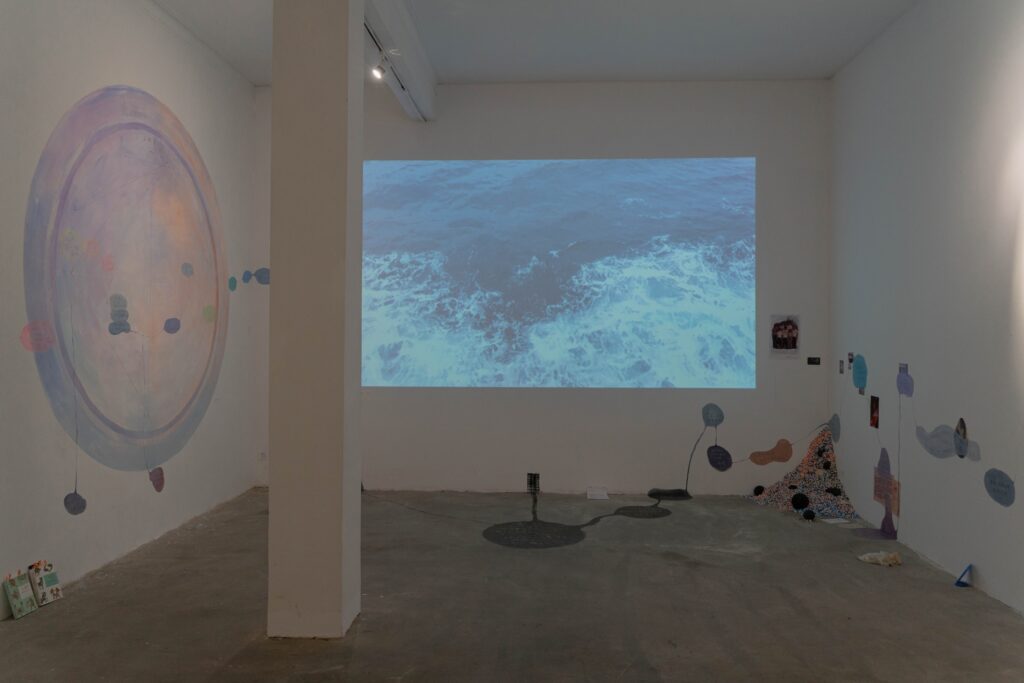
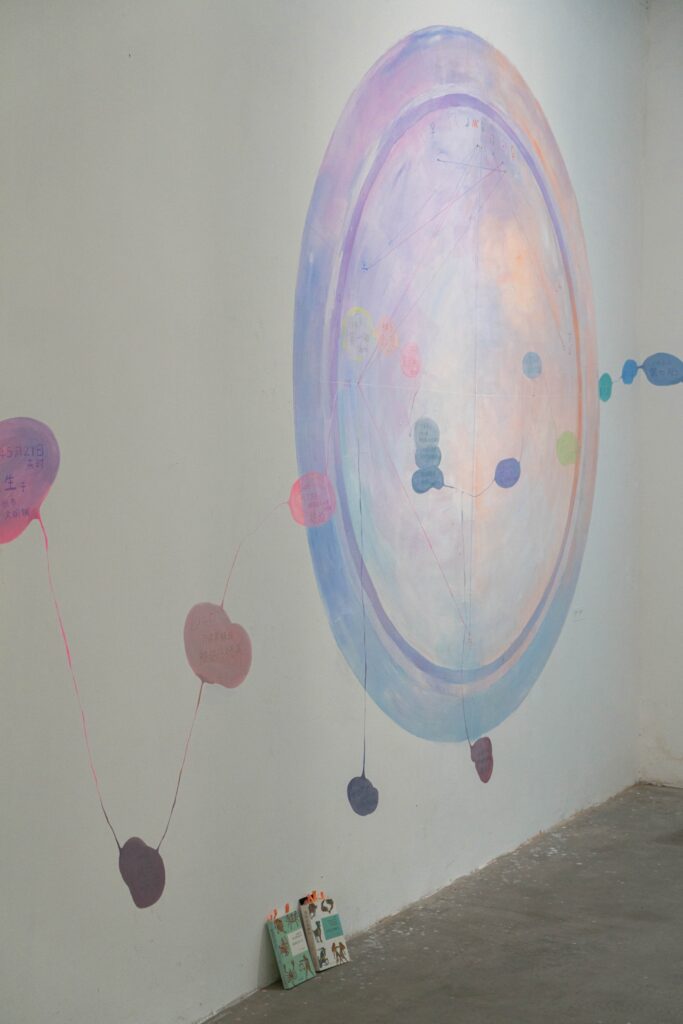
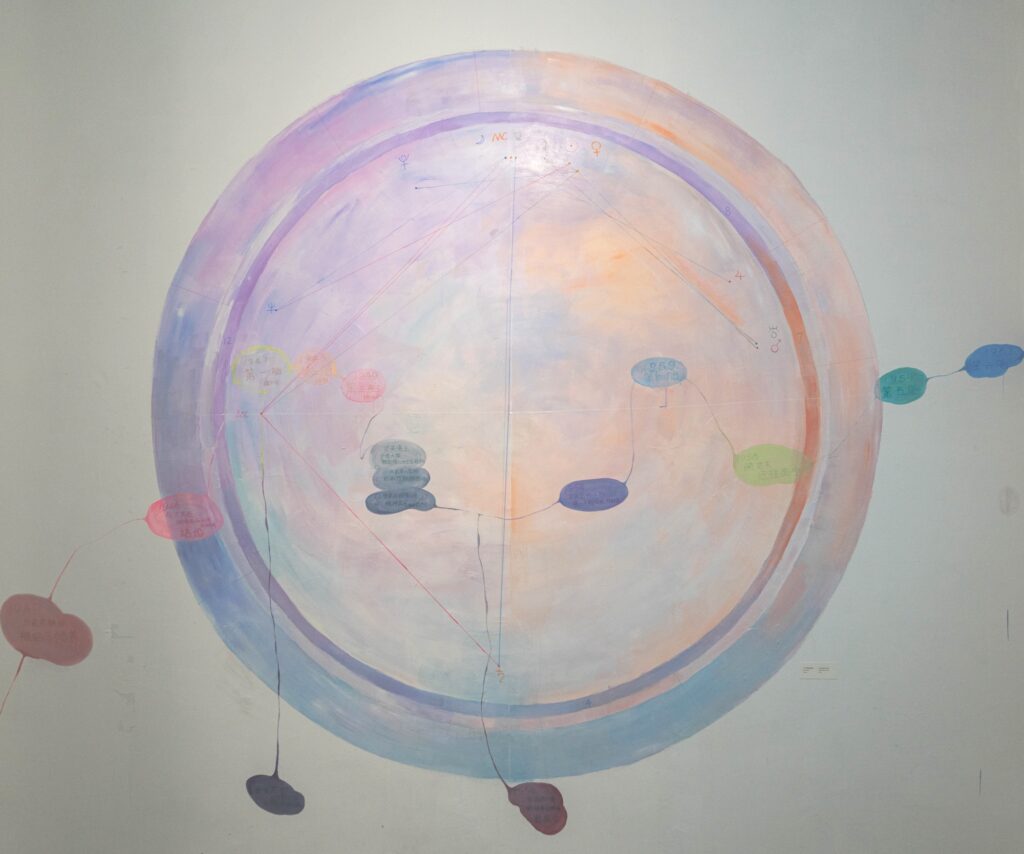
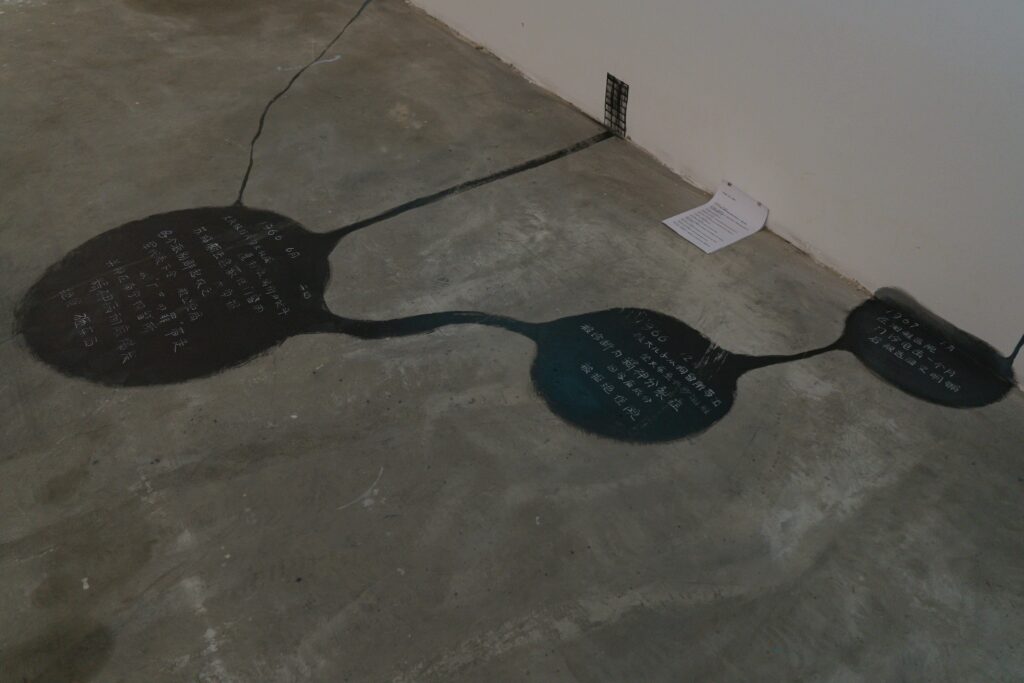
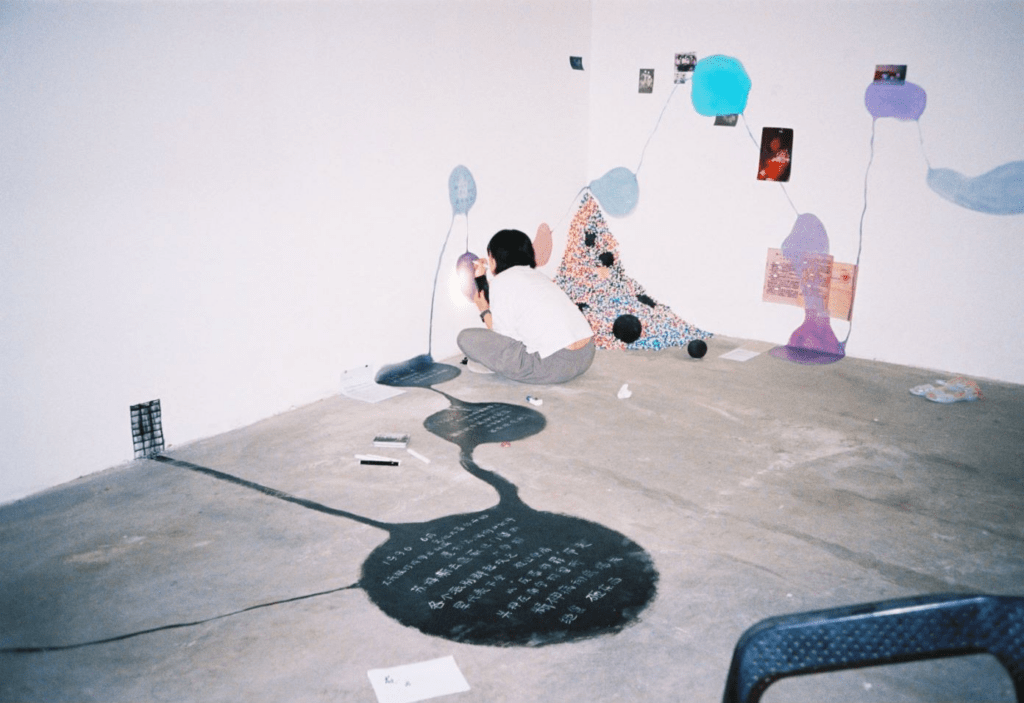
The birth chart of Sumei : Acrylic, Mixed media on wall, 3*3(m)
《关于外婆星盘的研究》:墙上综合材料,3*3(米)
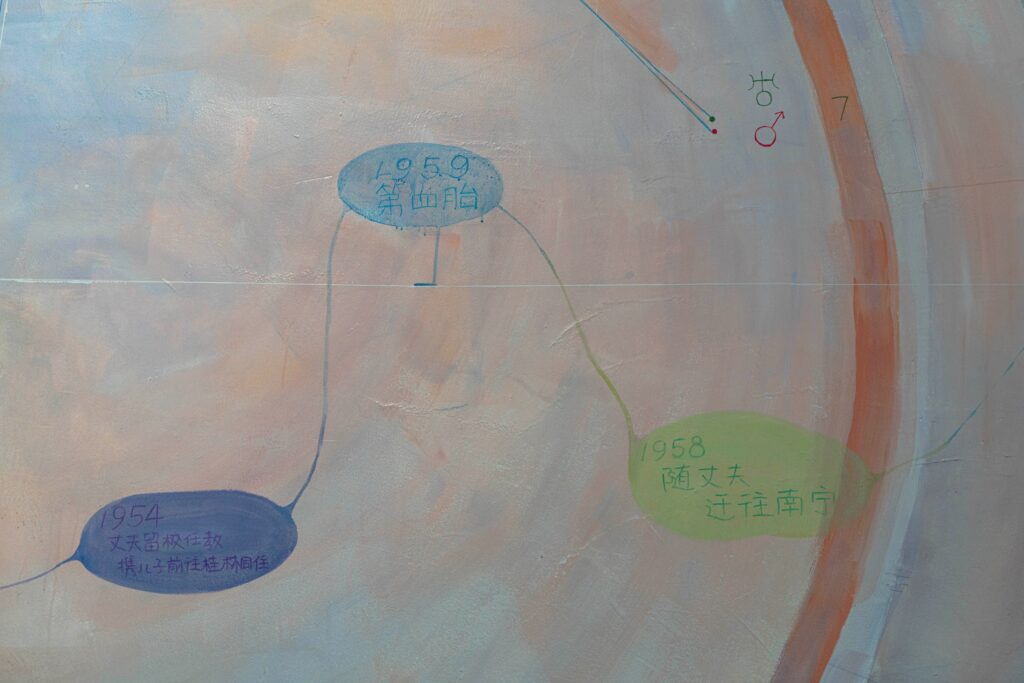
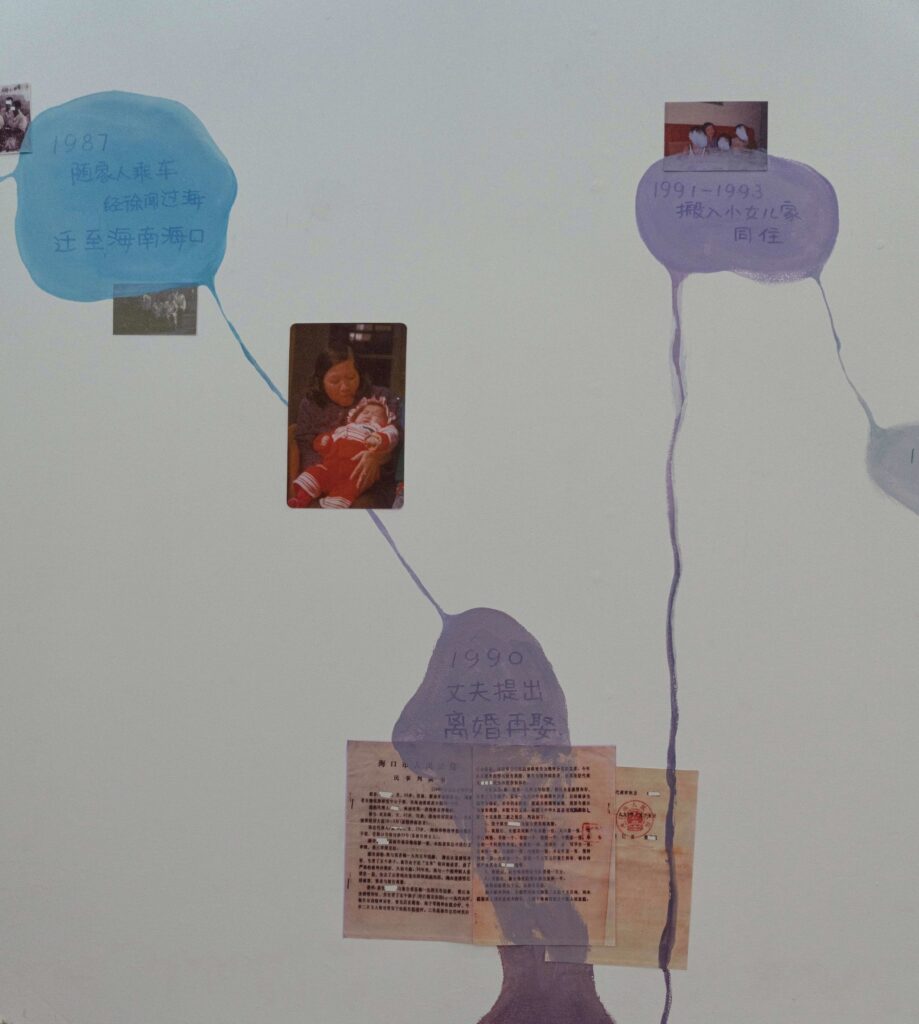
Sumei : Acrylic, pencil, charcoal, wall painting, 20*3(m)
《苏梅》:丙烯、铅笔,炭笔,墙面绘画,20*3(米)

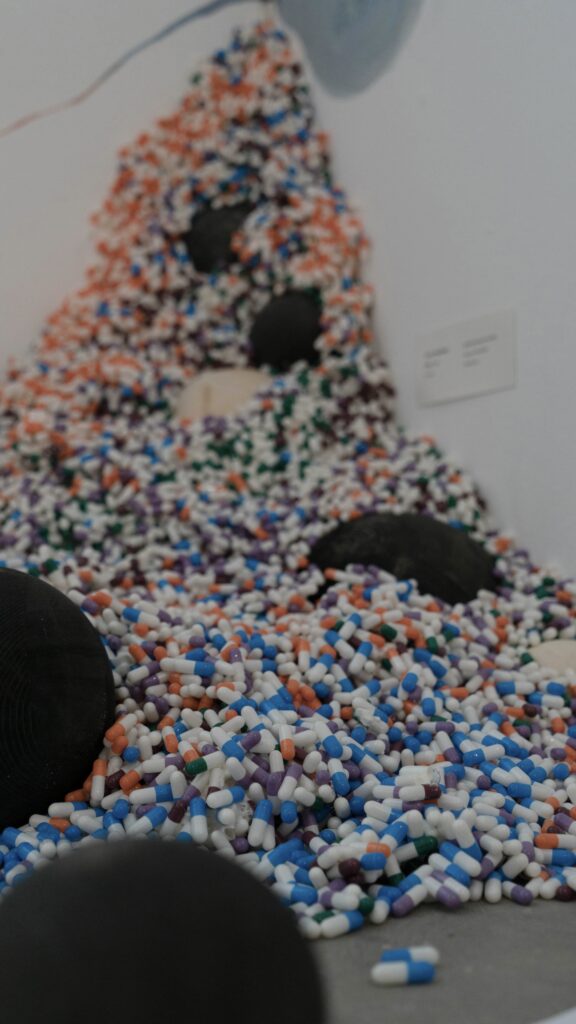
Untitled(Portrait of Sumei) : capsules, wooden balls, dimensions variable
《无题(外婆的肖像)》Untitled (Portrait of Sumei):空胶囊,木球,尺寸可变
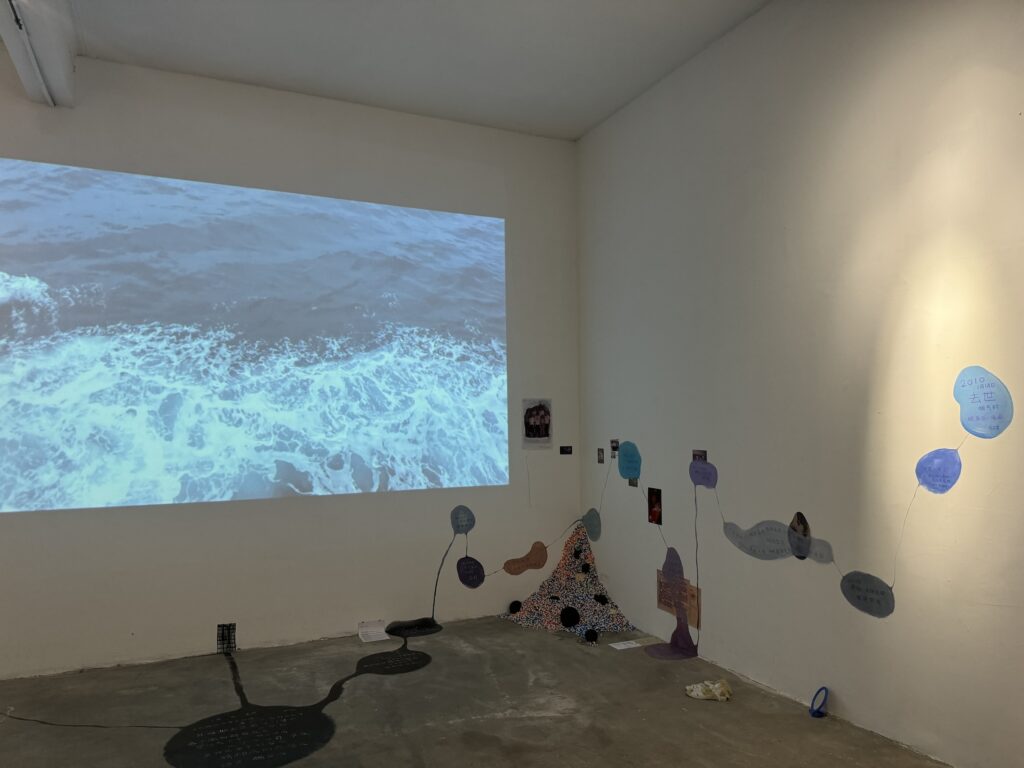

Waves,Soliloquy : video 14:02 , dimensions variable
《海,自言自语》:影像14:02 尺寸可变
Timeline of Su Mei’s Life
(1) Born on May 21, 1928, at midnight in Wenmingpu Town(In Chinese, it means “civilized town”.), Qiyang County, Yongzhou City, Hunan Province.
(2) 1930s-1940s – Both parents passed away.
(3) Around 1940 – She and her siblings were adopted by their aunt.
(4) 1946 – Married in Wenmingpu Town, Qiyang County, Yongzhou City, Hunan Province.
(5) 1947 – Gave birth to her first child, a daughter.
(6) Her eldest daughter passed away due to suffocation while she was inexperienced in childcare, leading to a tragic incident.
(7) 1948 – Gave birth to her second child, a son.
(8) 1949 – Gave birth to her third child, a daughter.
(9) 1950 – Husband enrolled at Guangxi University, prompting her to move to Guilin, Guangxi, with her son and daughter.
-Her younger brother joined the military academy, later sent to the first campaign of the War to Resist US Aggression and Aid Korea.
-Her cousin was arrested for a mistaken slogan during the resistance in the the first campaign of the War to Resist US Aggression and Aid Korea, leading to mental illness and labor reform.
(10) 1953 – Her daughter, afflicted with rickets, was taken back to Hunan Province at the age of 4 by her sister-in-law and later passed away under unclear circumstances.
(11) 1954 – After her husband’s graduation, they settled in Yan Shan, Guilin, with their son.
(12) 1956 – Gave birth to her fourth child, a daughter.
(13) 1958 – Relocated with her family to Nanning, residing at the Teaching Experimental Farm of the Guangxi College of Agriculture.
(14) 1959 – Gave birth to her fifth child, a daughter.
(15) 1961 – Gave birth to her sixth child, a daughter.
(16) 1962 – Gave birth to her seventh child, a son.
(17) 1962 – Underwent sterilization surgery.
(18) 1963 – Experienced postpartum depression, leading to self-talk and the initiation of tranquilizers under doctor’s guidance.
(19) June 1966 – The Cultural Revolution began, and her husband was denounced as a reactionary academic authority. Their home was ransacked, paraded through the streets, publicly criticized, and the door and windows of their residence plastered with big-character posters. Various factions rose against them, with the military representative issuing orders. Subsequently, She was taken away by the public security bureau on charges of “counterrevolution.” She was then detained in the Nanning detention center. Inside the detention center, his mental state deteriorated drastically, leading to hunger strikes and acts of vandalism.
(20) December 1966 – Her eldest son rescued her from detention and took her to Xiangya Hospital Psychiatric Department in Changsha City, Hunan, Province, diagnosed with schizophrenia, being denied hospital admission due to a background as a landlord.
(21) January 1967 – After a month of outpatient electroconvulsive therapy at Xiangya Hospital, her eldest son took her to recuperate at the home of her second brother in Wenmingpu Town, Qiyang County, Yangzhou City, Hunan province (She is only allowed to return to the place of her birth.).
(22) August 1968 – Her eldest son accompanied by her two sisters and one brother, brought Su Mei back from their home in Hunan to Nanning, where her condition improved.
(23) End of 1968 – Experienced another bout of mental illness. Her second daughter accompanied her for treatment at the Guangxi Hospital Of Traditional Chinese Medicine.
(24) 1970 – Moved outside the Guangxi Agricultural College to manage her mental health, later returning to the college after 1982.
(25) Over the next decade after 1970, Su Mei was repeatedly hospitalized in Nanning due to psychiatric relapses.
(26) 1987 – Moved to Hainan, crossing from Nanning through Xuwen Port in Guangdong Province on a large truck with the family’s belongings to live in a detached courtyard within the provincial government compound in Haikou.
(27) 1990 – Husband filed for divorce and remarriage. Court granted the divorce.
(28) 1990 – Hospitalized for treatment at Anning Hospital(Psychiatric Hospital) in Haikou, Hainan (medication and electroconvulsive therapy).
(29) 1991-1993 – Moved in with her youngest daughter, residing in the dormitory building of the Hainan Provincial Department of Science and Technology.
(30) 1990 – Su Mei was relocated to a residential area in the government compound in Haikou, Hainan. She frequently wandered away but was brought back home by her children.
(31) 2006 – Fell and fractured her pelvis, leading to exacerbated health issues, inability to move, and reliance on others for care. Her eldest daughter stayed with her, but she refused food and required intravenous nutrition in the hospital.
(32) January 13, 2010 – Su Mei suddenly said, “I am going up to sky ,” instructing her daughter to inform her ex-husband (daughter did not relay the message).
(33) January 14, 2010 – Su Mei passed away at the age of 82, shedding a tear as she took her last breath.
This project (Inner Symbol) is an objectification of self-exploration into mood swings during self-quarantine, with reflection particularly on women’s social status, as well as dynamics between social norms and the physiological instinct as women. Not only a product of self-reflexivity and self-inquiry, this is also an examination into the predicament of women.
This project aims at attracting more social attention on feminist arts within East Asian context. Meanwhile, self-caring and positive attitudes are encouraged through this project among more women, especially girls undergoing the phase of value formation, in the face of gender conundrum.
这一个人项目创作于自我隔离期间,摸索自己的情绪波动及流向,以及将它视觉化的结果,在创作过程使我不断反思自己,尤其是作为女性的社会处境,以及作为女性所接受的身份教育以及身体本能之间的关系。它既是我对自己的不断自省和溯源,也是我对女性身份困境的追问。
借此作品,我希望能东亚社会语境下,引起更多观者对女性主义作品的关注,也希望能让更多的女性,尤其是仍在思维形成阶段的女孩子,更多的关注自身,积极地面对自己的性别困境。
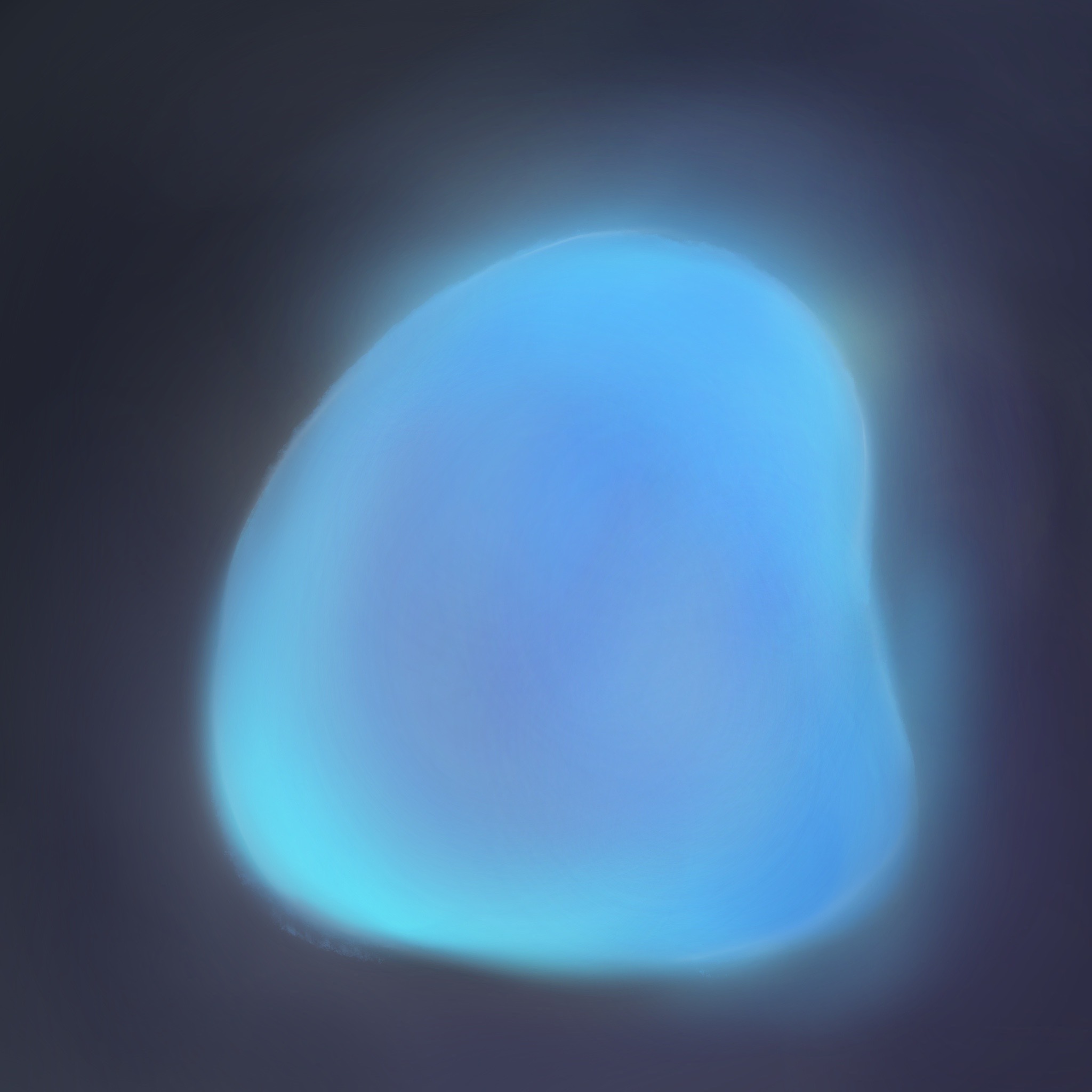
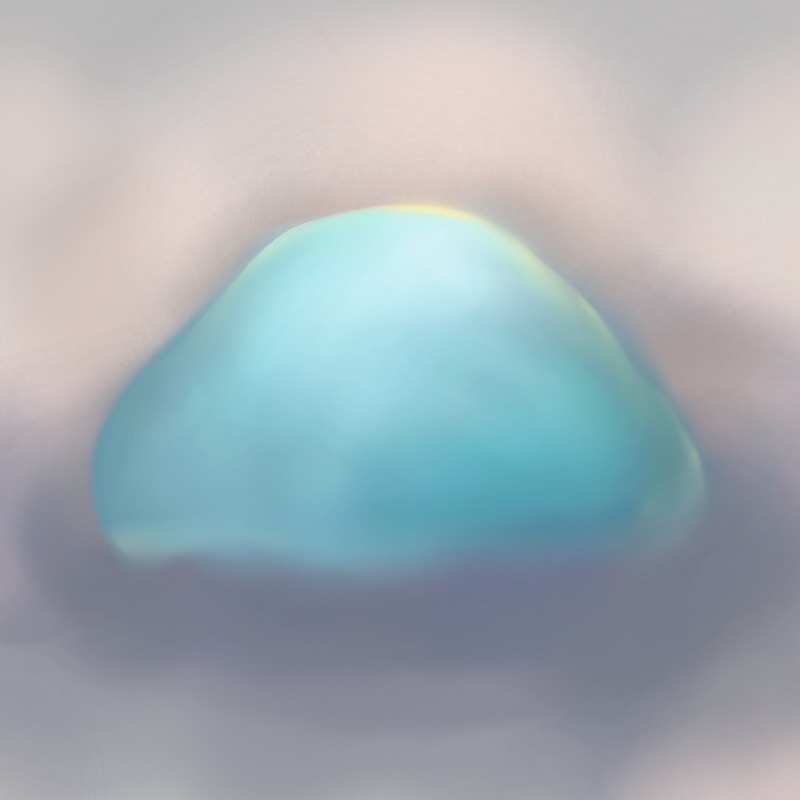

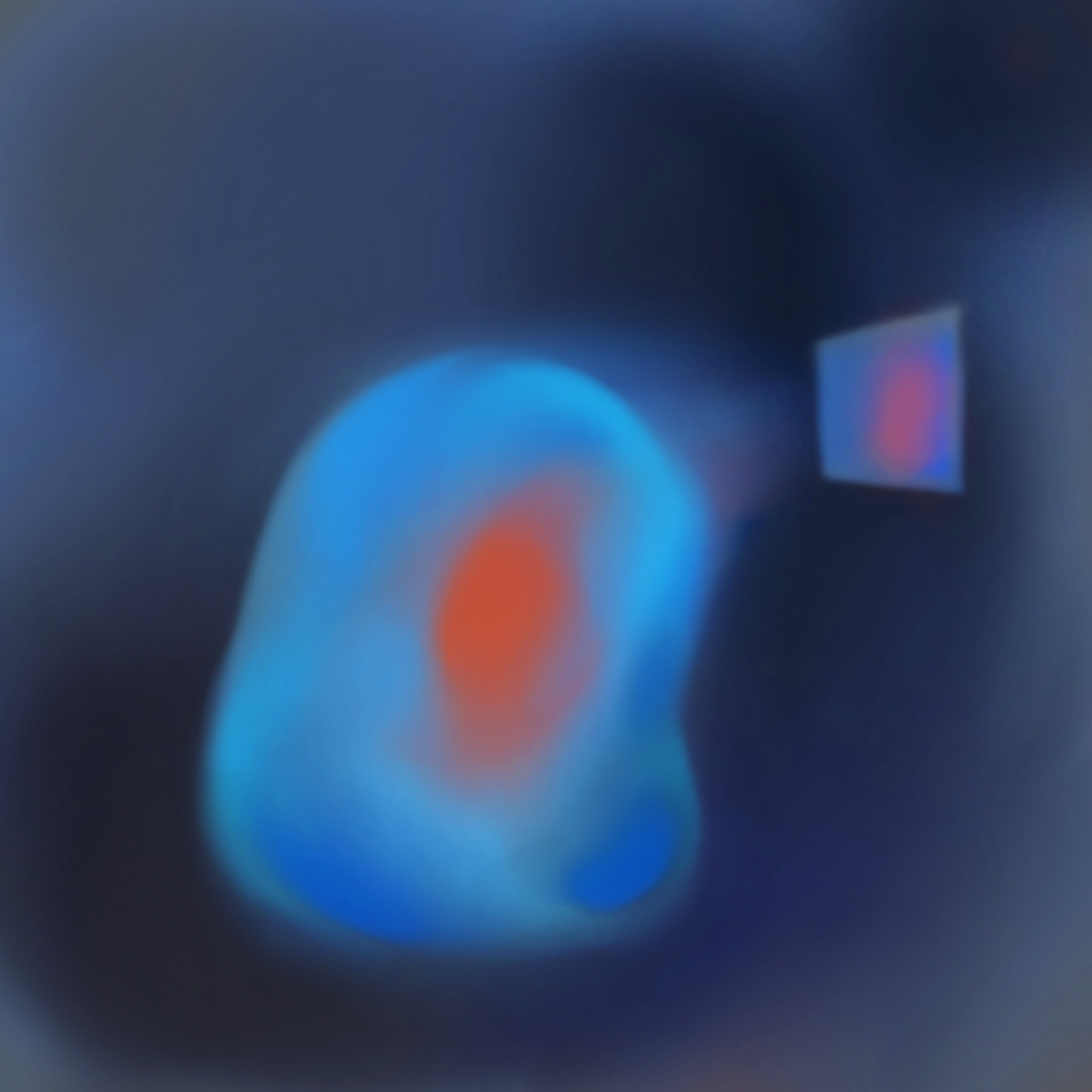

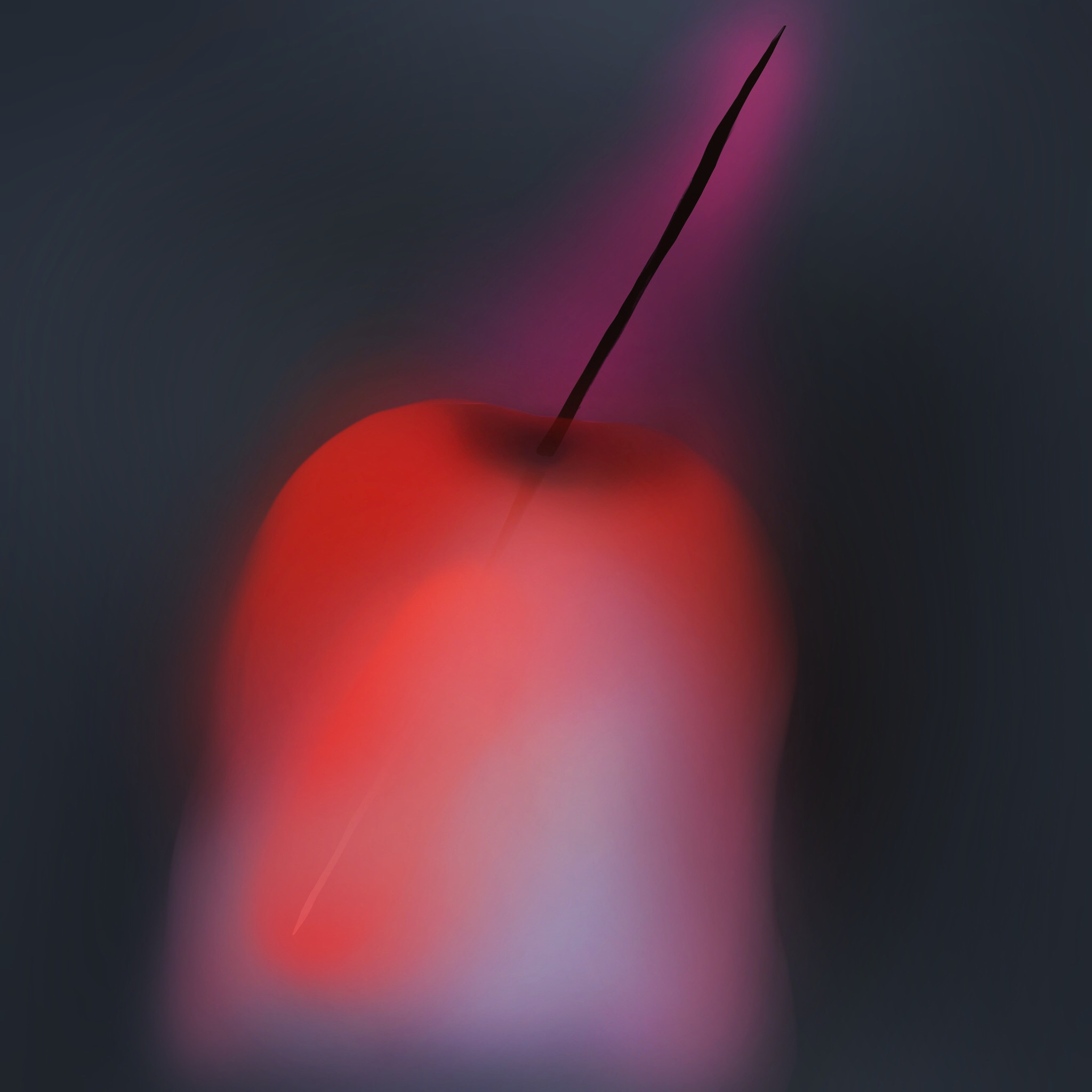
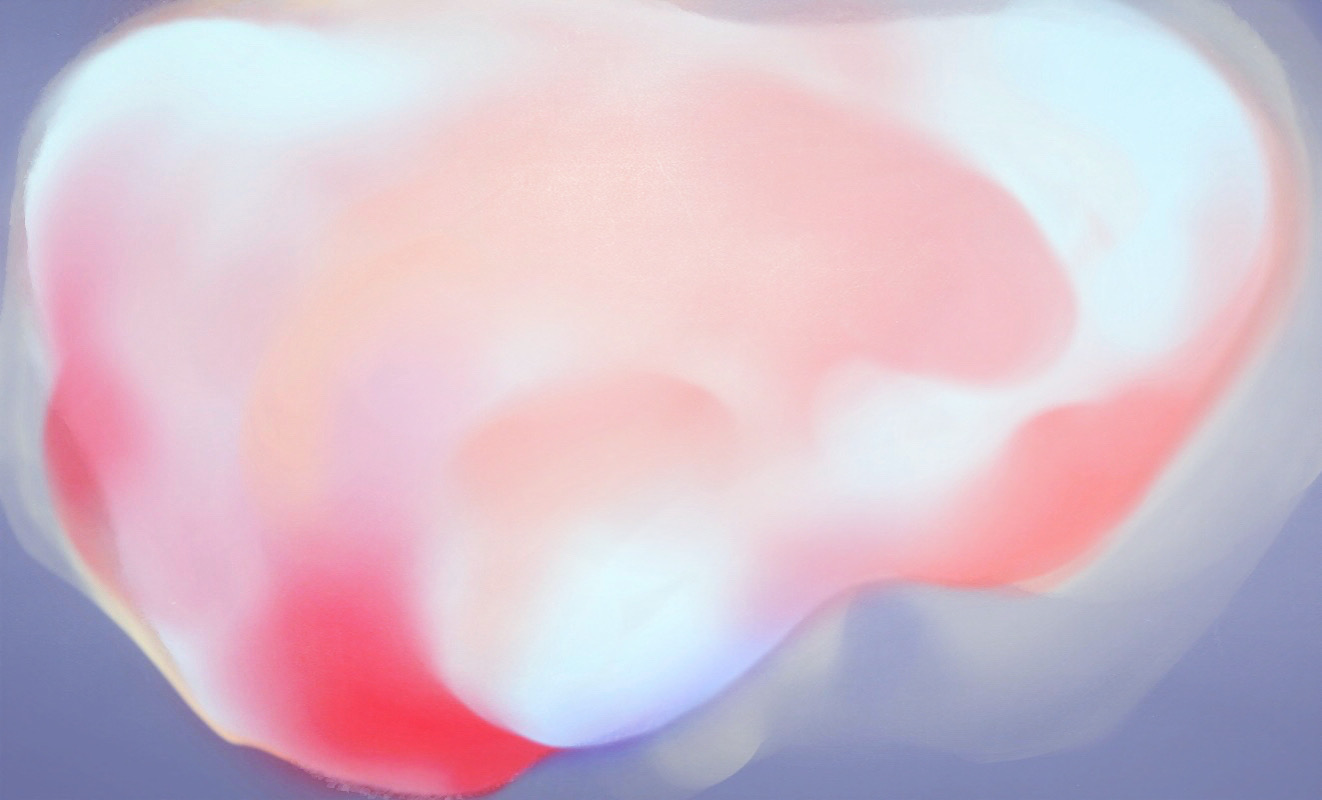
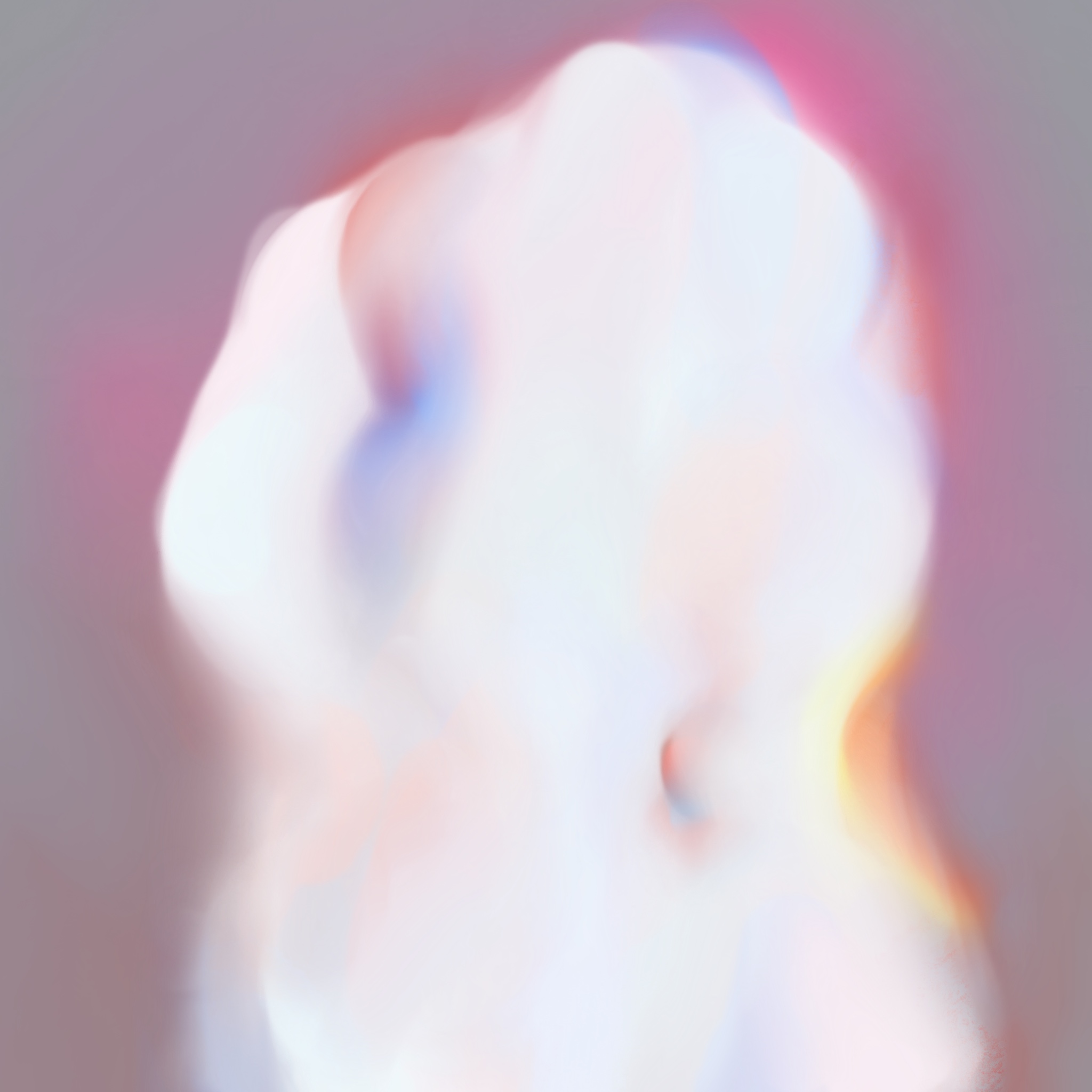
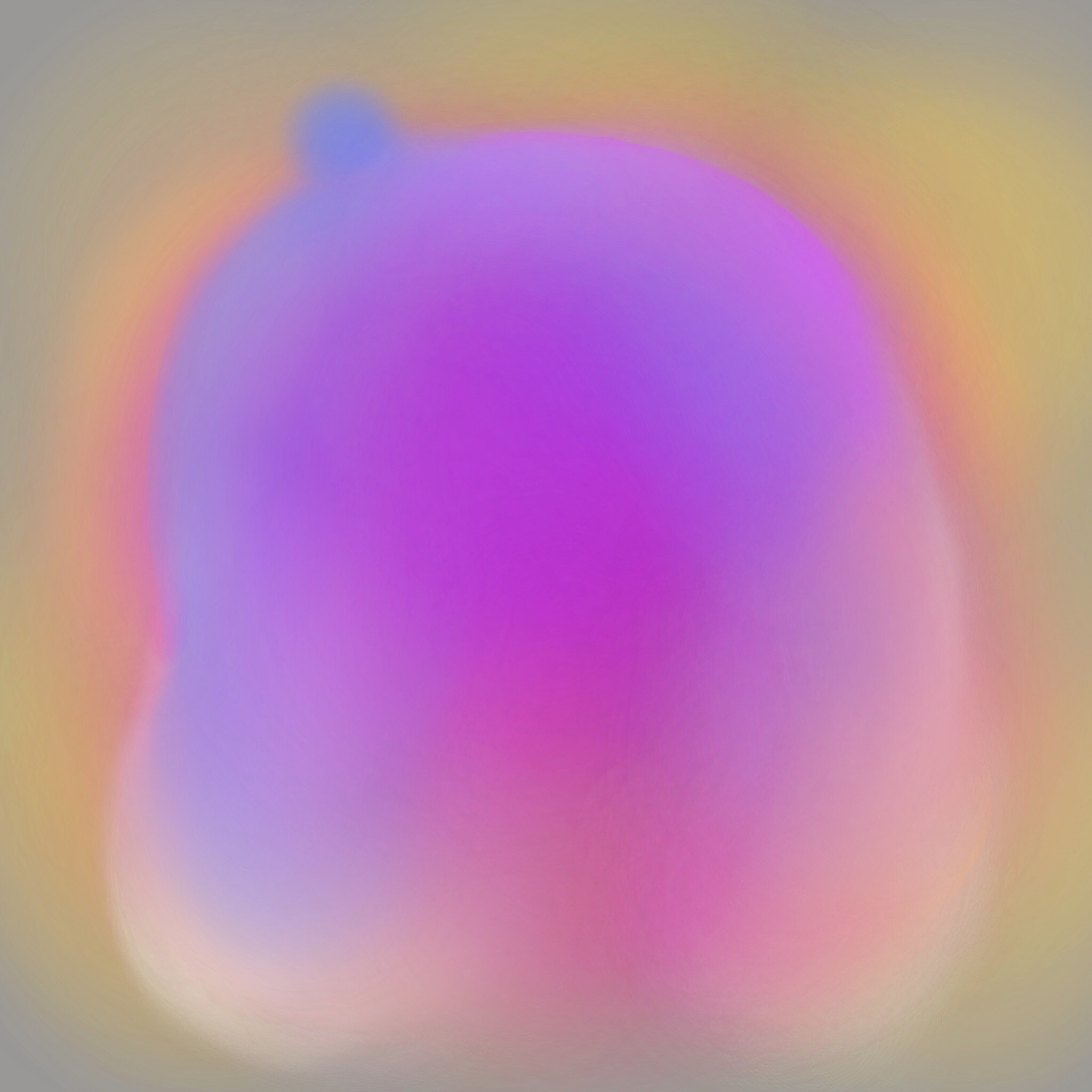



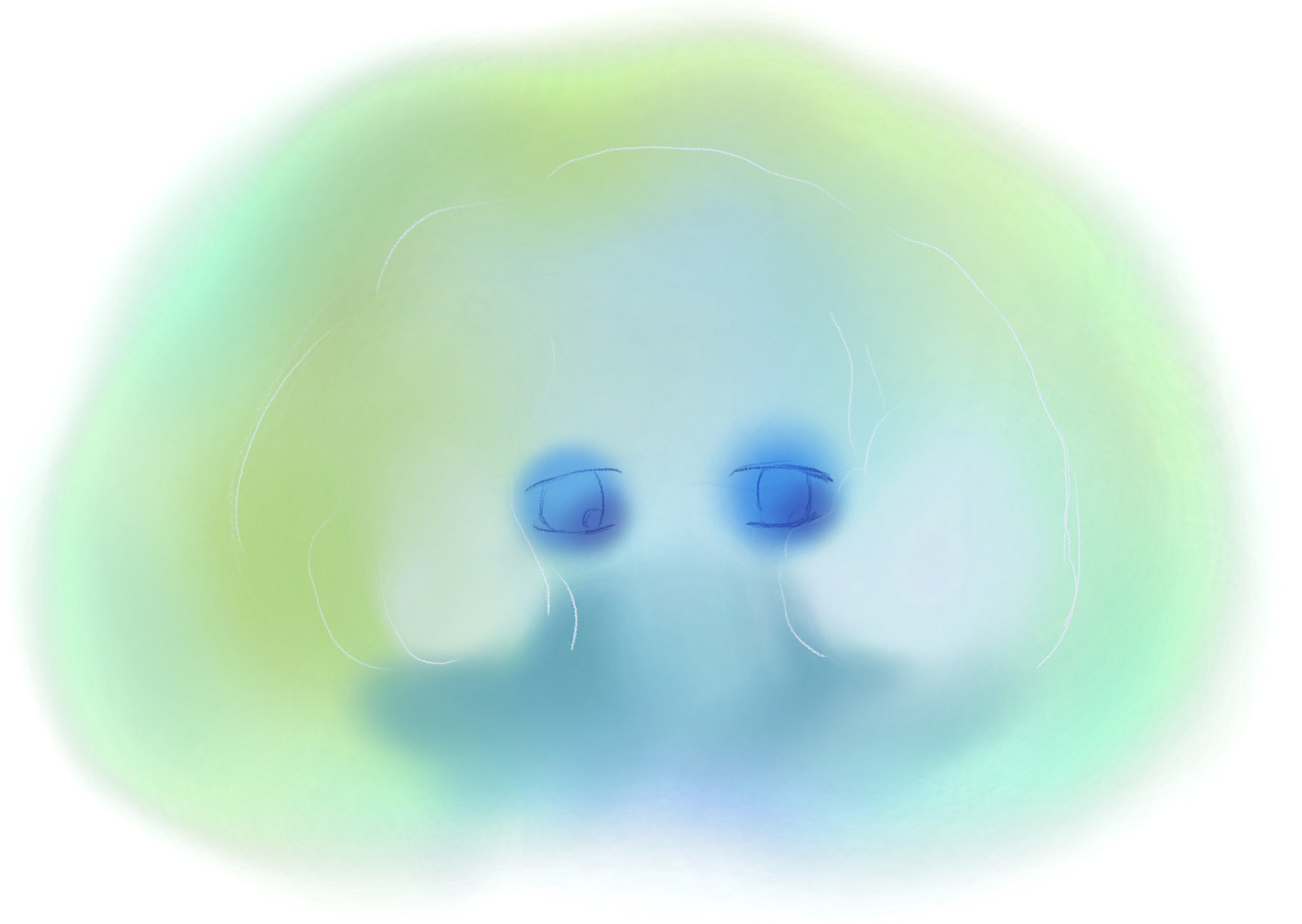
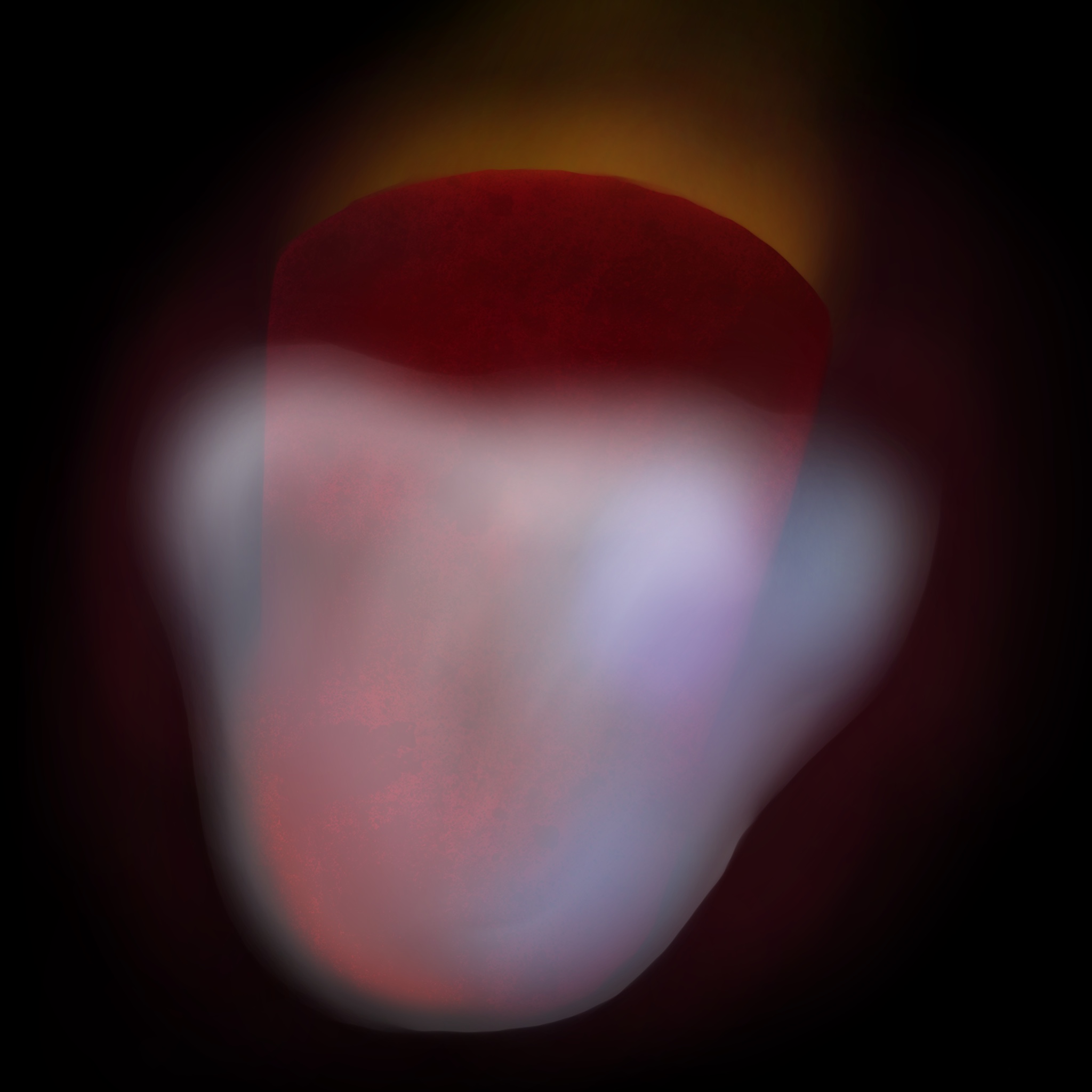

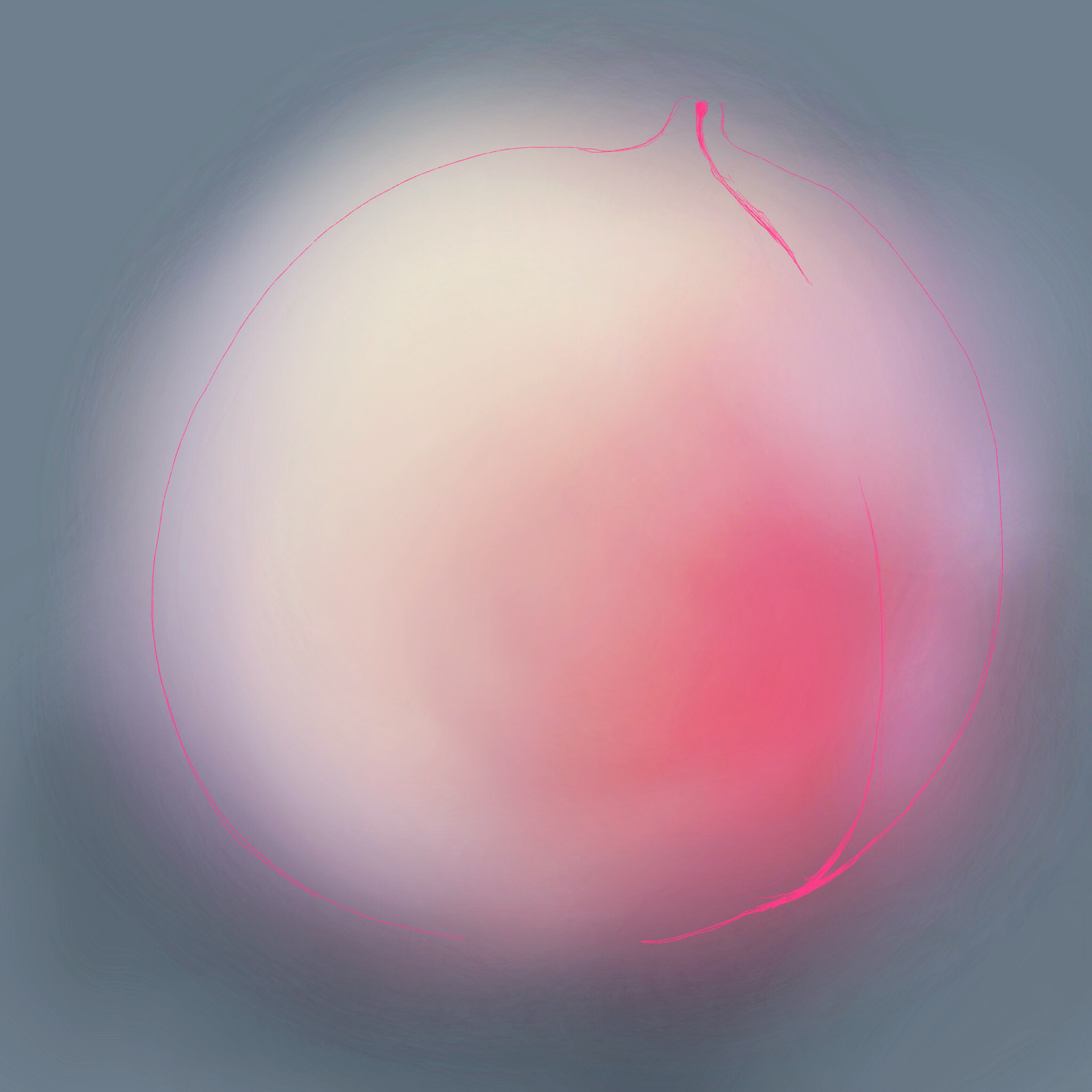
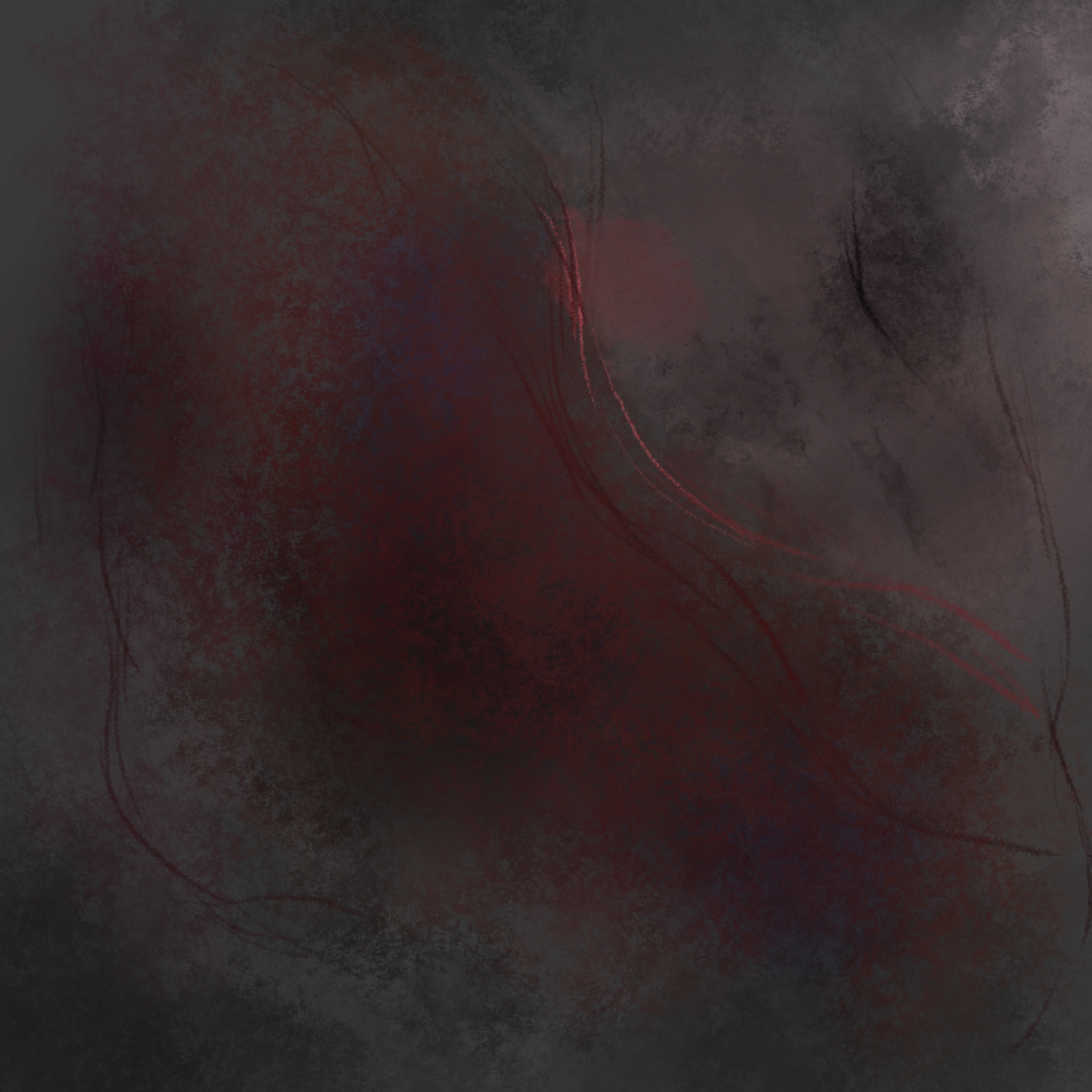






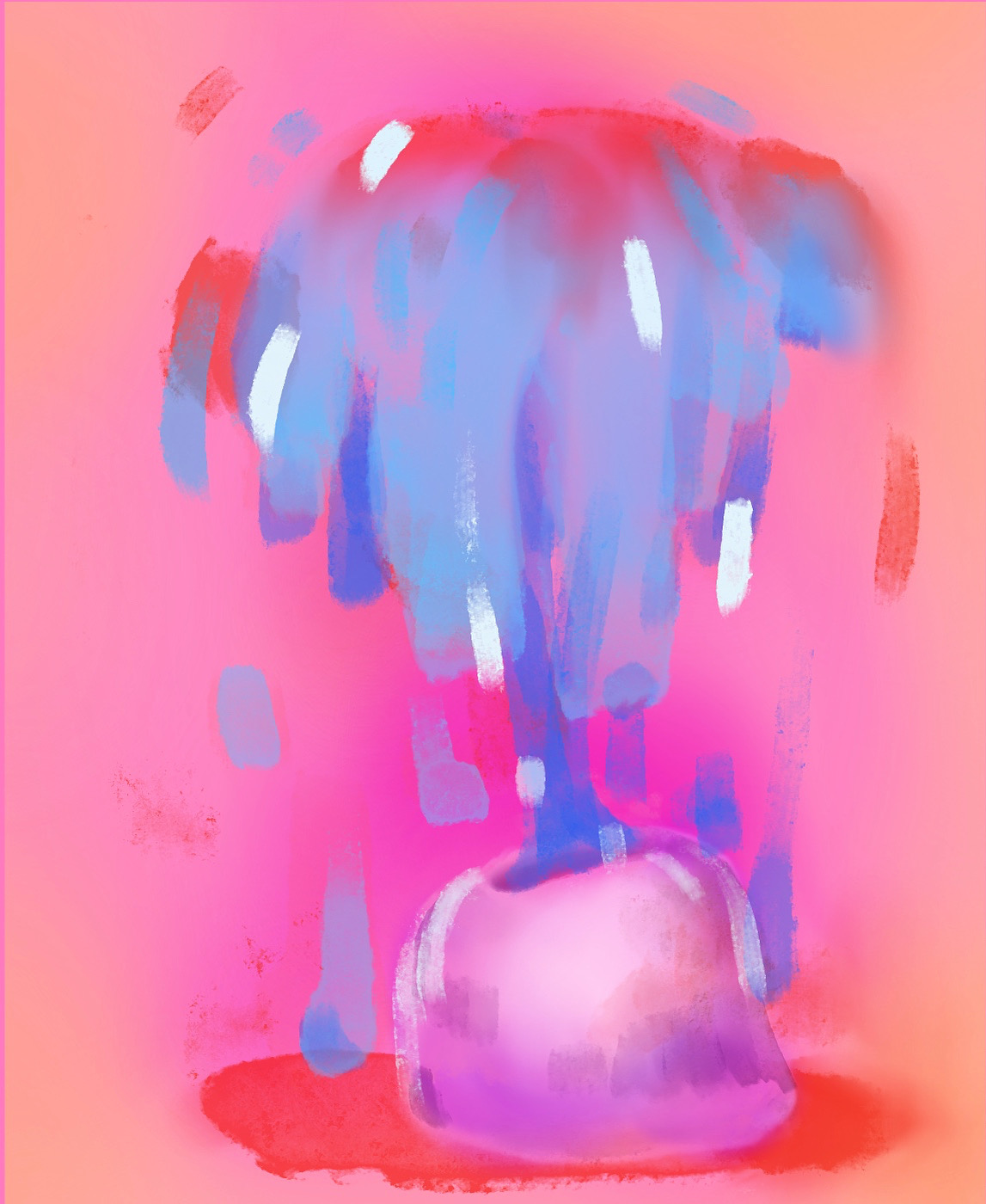
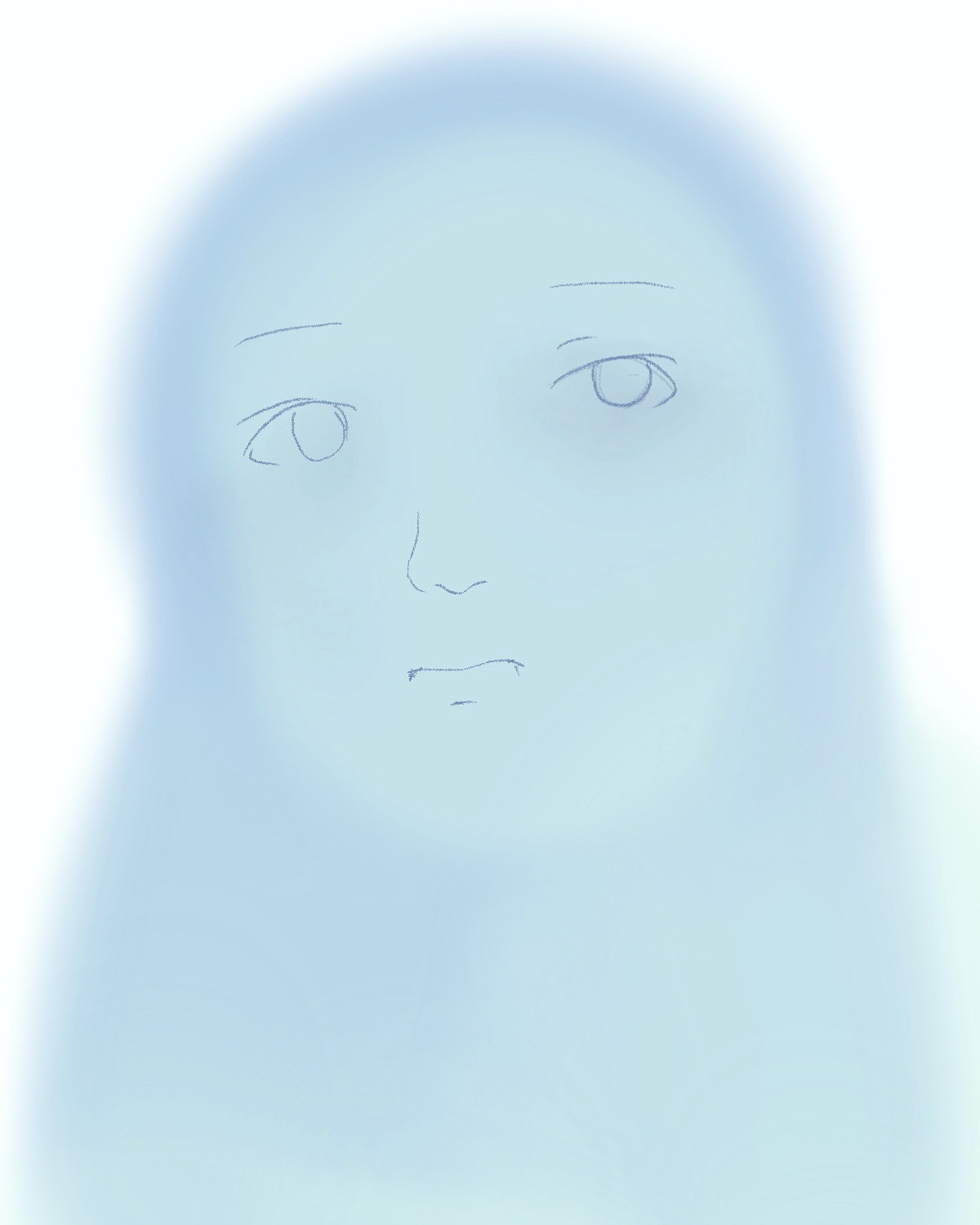
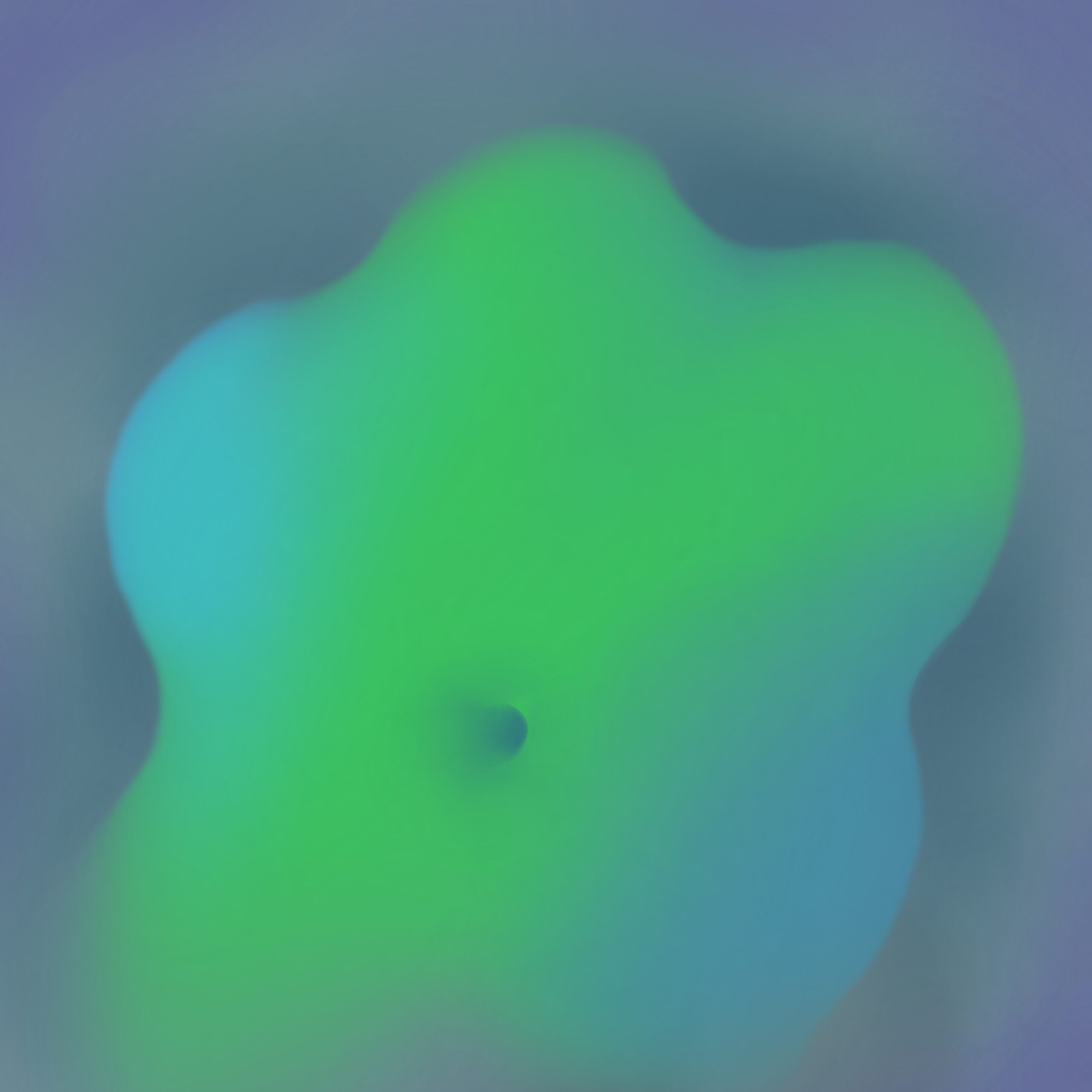
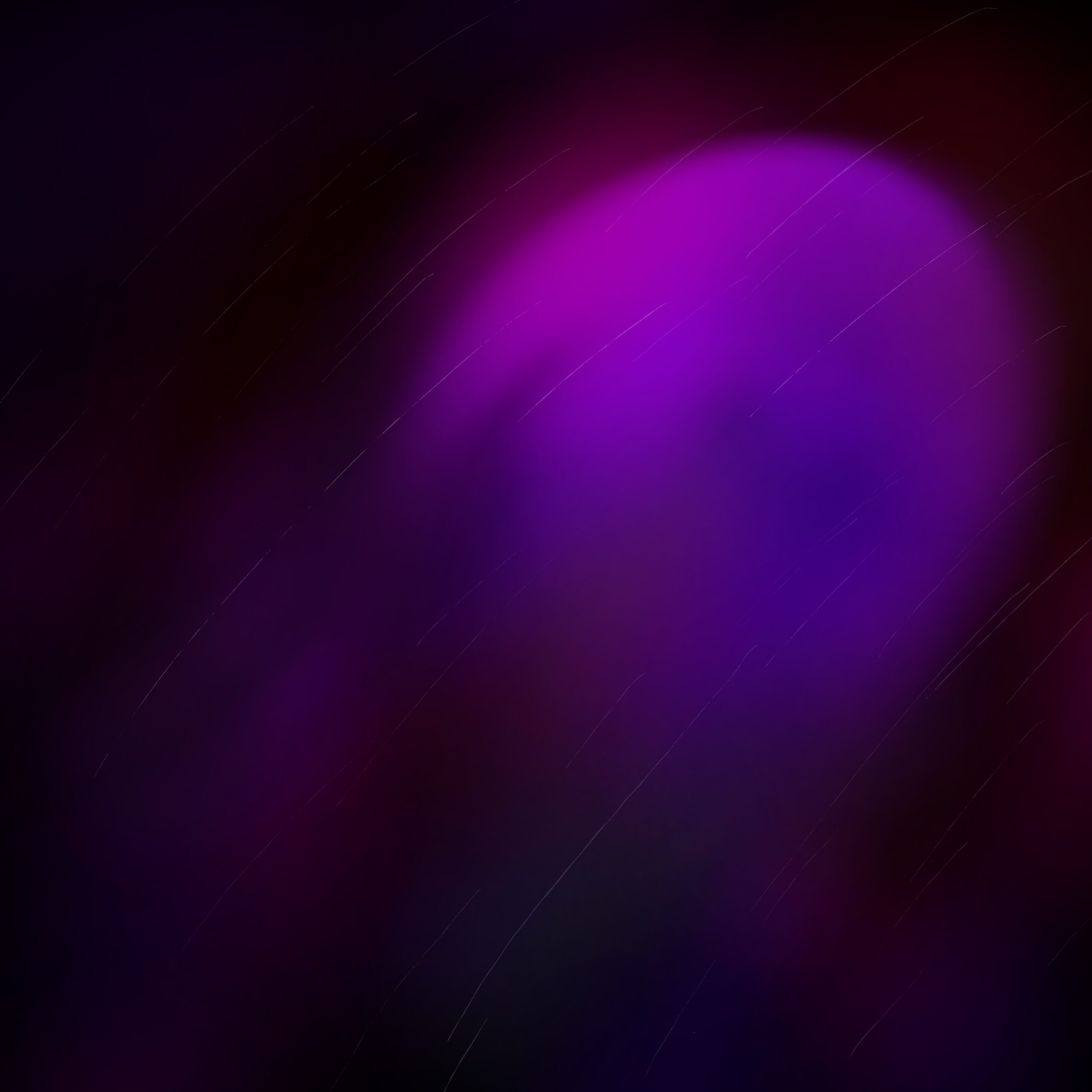






















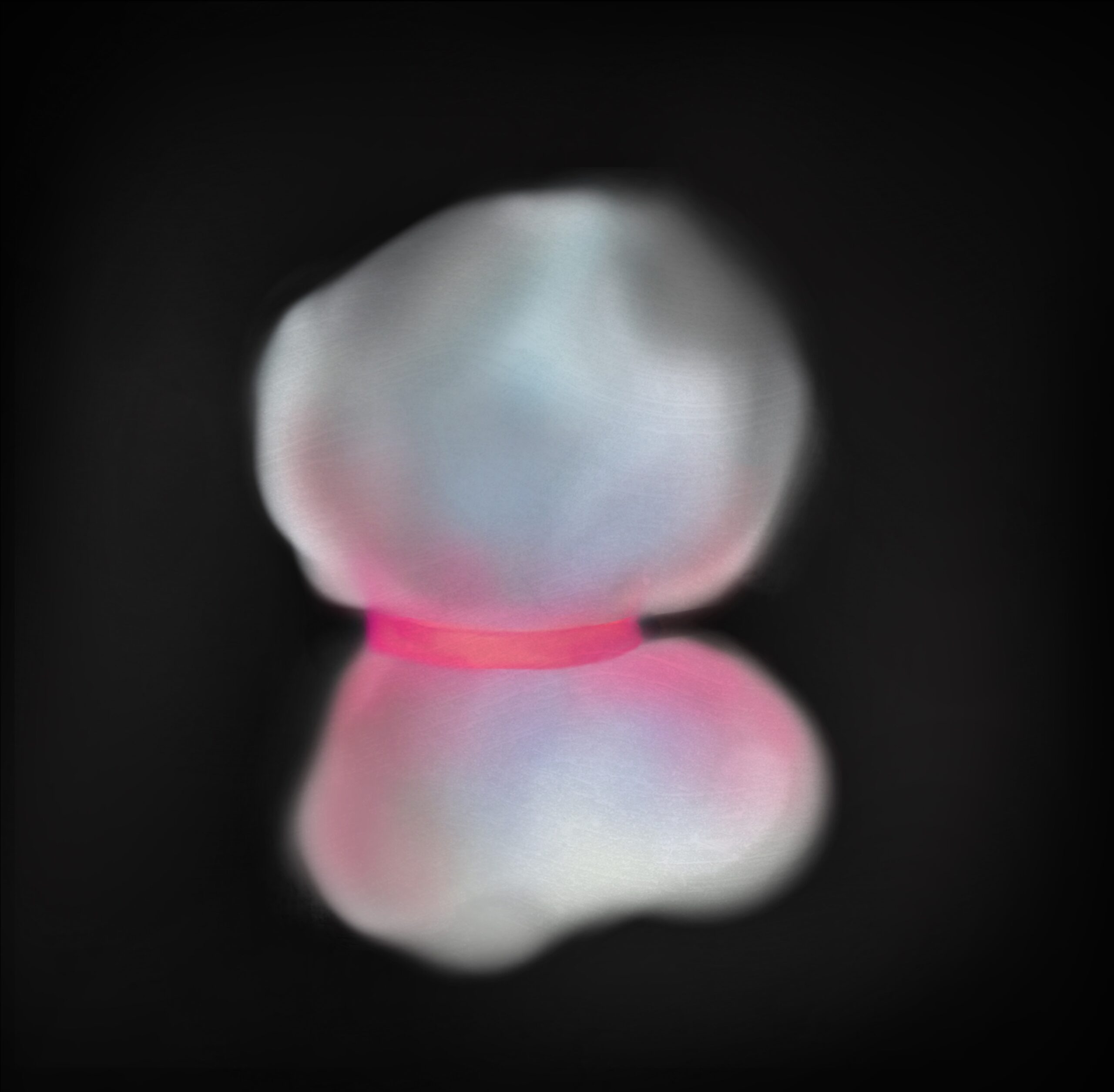
By Awareness with the series of works centered on bodily perceptions, I aim to sculpt and depict abstract expressions of bodily experiences and inner perceptions. This process involves transitioning from conversing with the world to engaging in introspective dialogue, shifting the focus from external to internal scrutiny of my own body and emotions. Through the most direct documentation of my personal experiences and bodily sensations, I seek to externalize my emotions and feelings, transforming the most intimate aspects of “self” into a public, universal narrative. While painting serves as my tool, it is the internal experiences that act as my creative medium. In the process of creation, all contemplations and tangled imageries metamorphose into rhythms, ultimately transforming into visual images.
身体感知系列作品是我塑造刻画到对身体经验、内在感知的抽象表达,这一过程中我从与世界的交谈退回到与自我对话,是对外部世界的移情到对自身身体和情绪审视的转变。我希望通过对我自身私人经验、身体感知体验的最直接的记录,将我的情绪和感受外化,将“我”最私域的东西转变成一种公开的、通用的讲述。绘画是我的手段但内在体验才是我的创作媒介。在创作过程中一切思考和混乱的意象都化为韵律,最后转化成视觉图像。
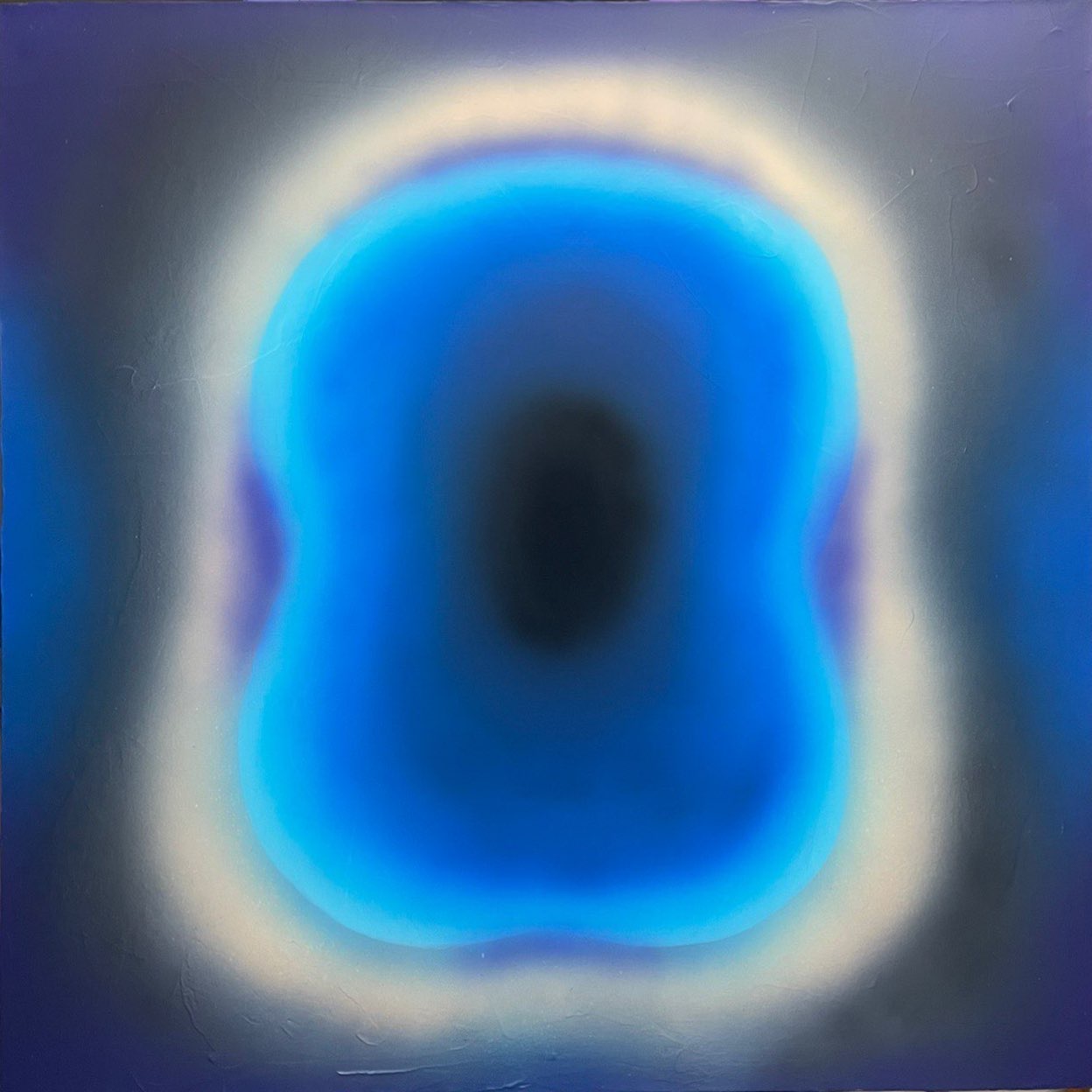
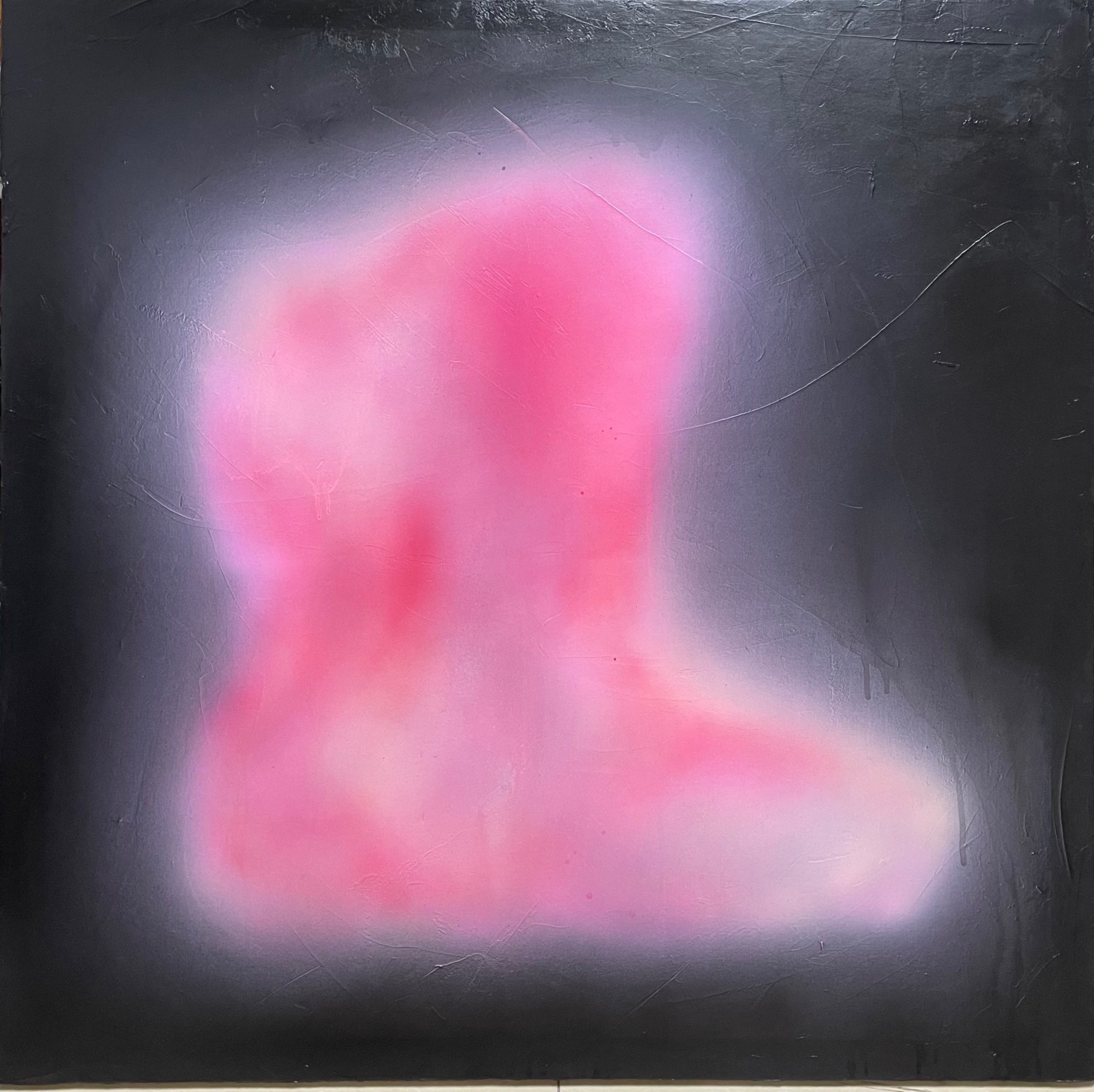
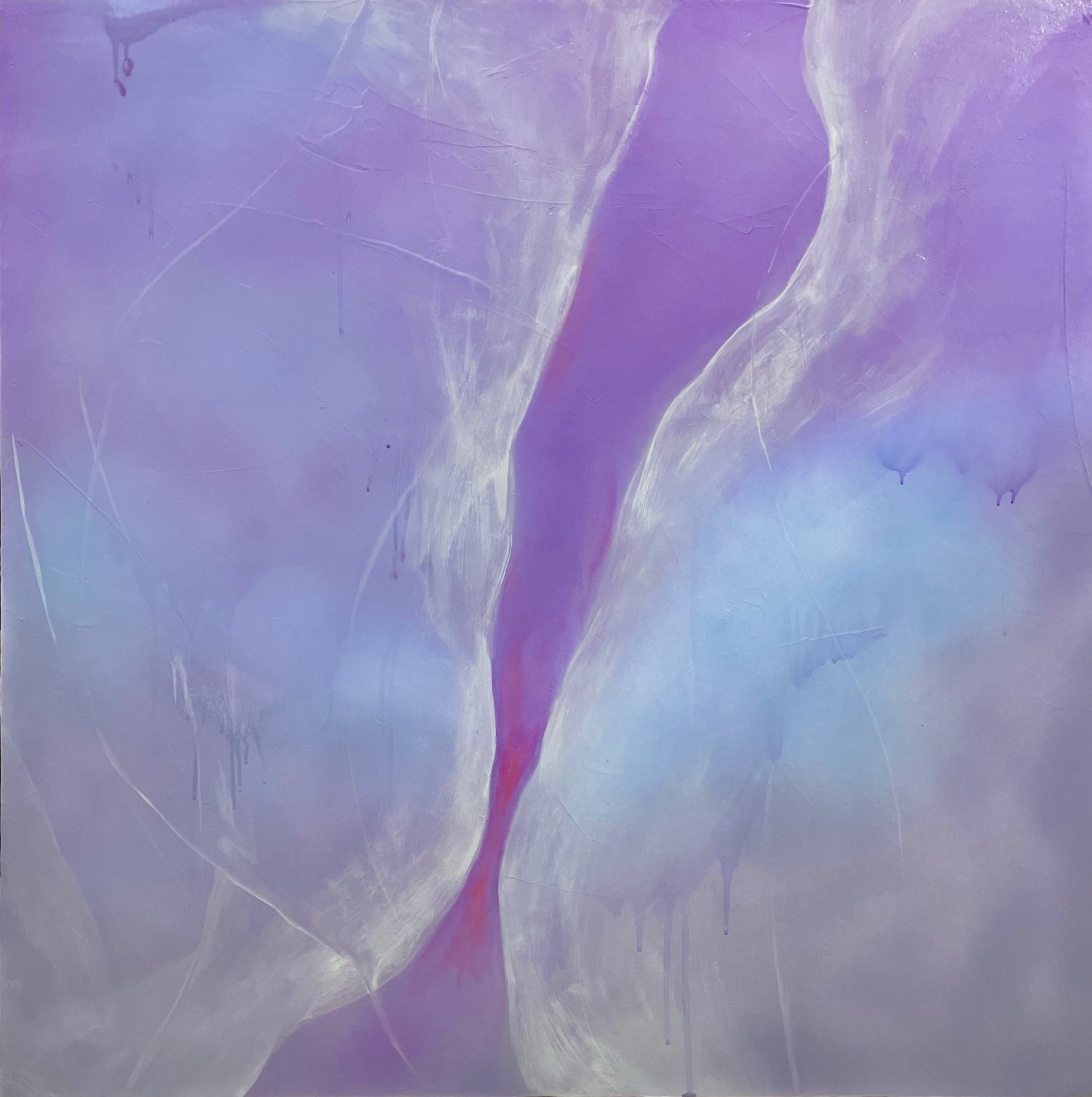
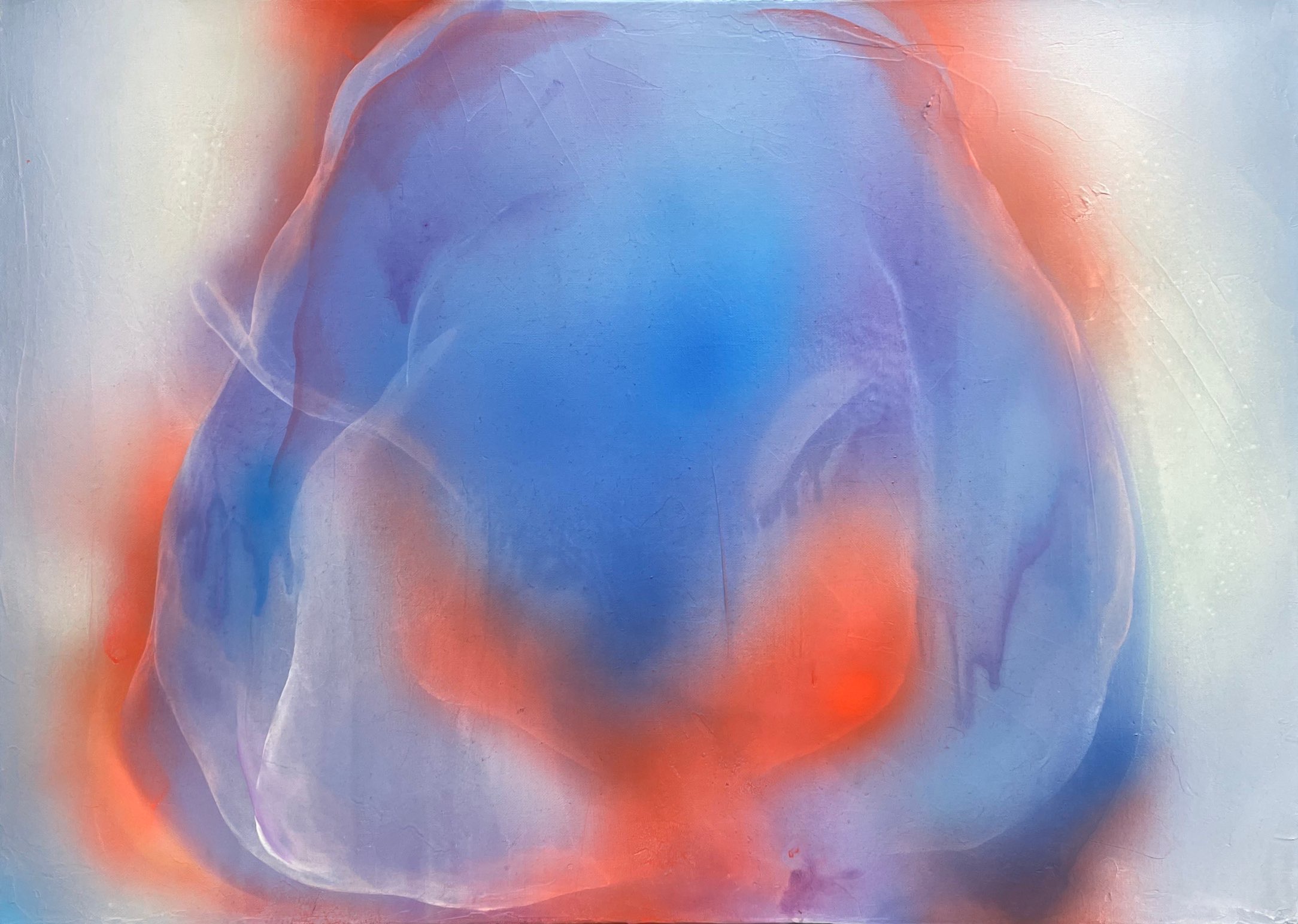
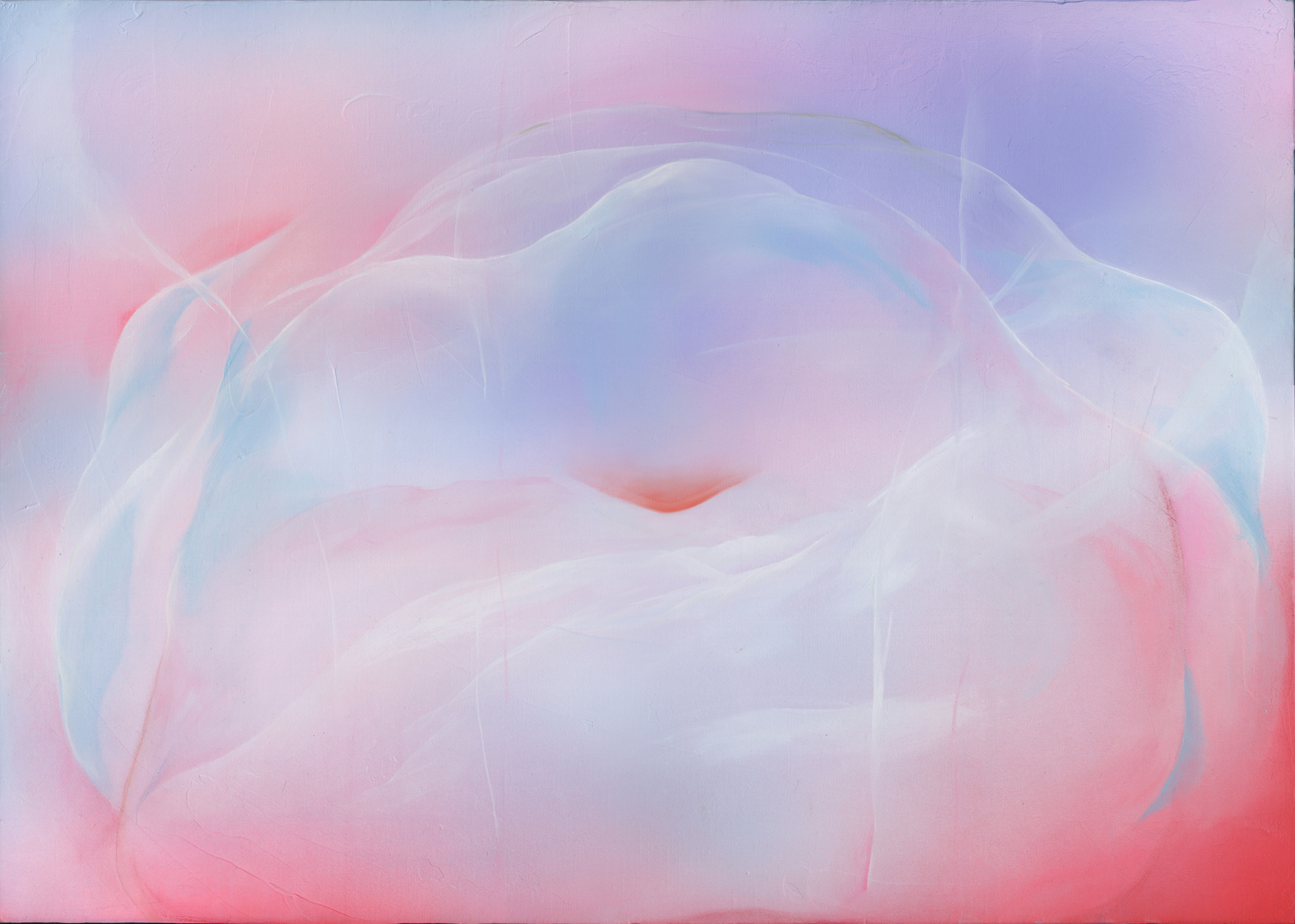
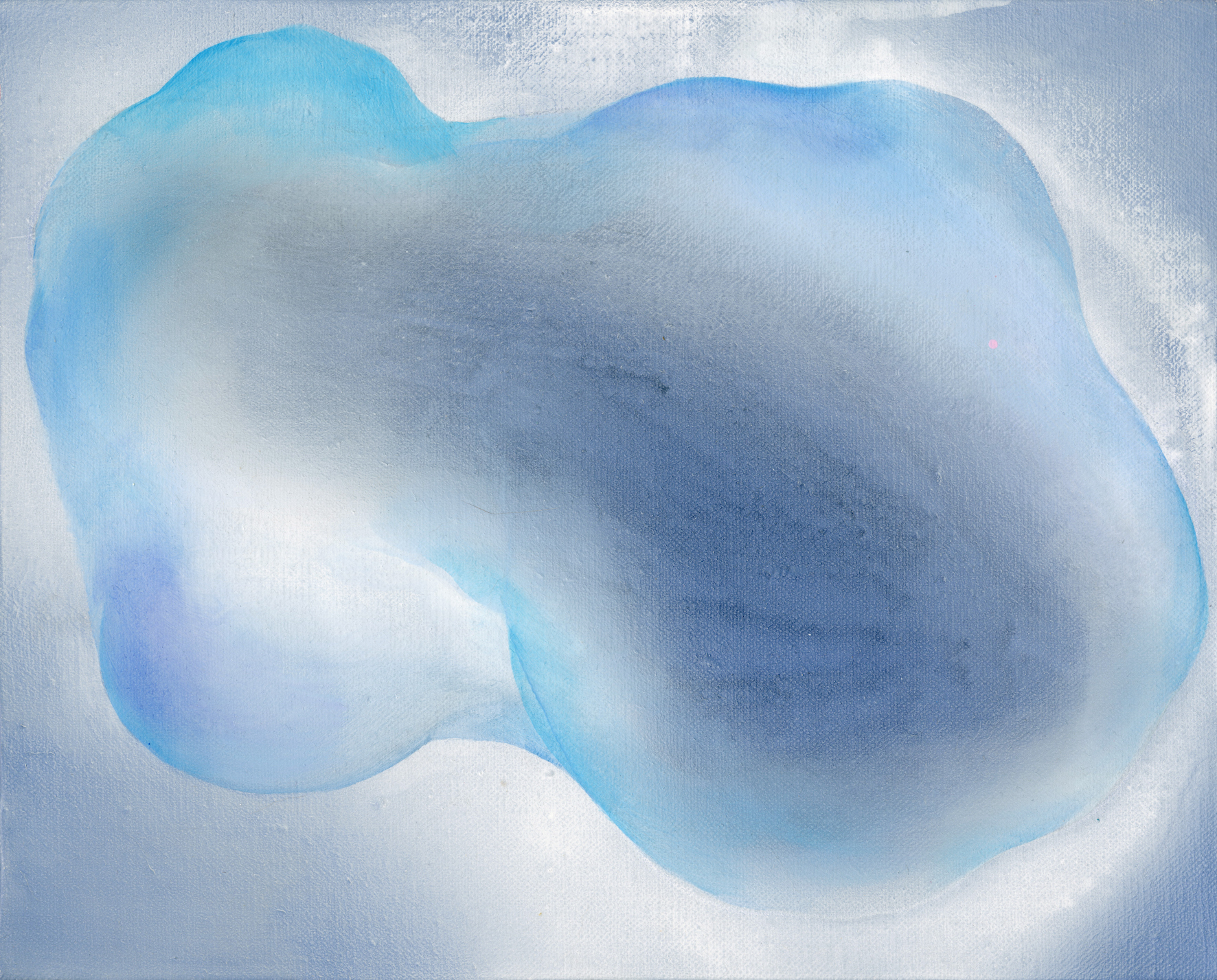
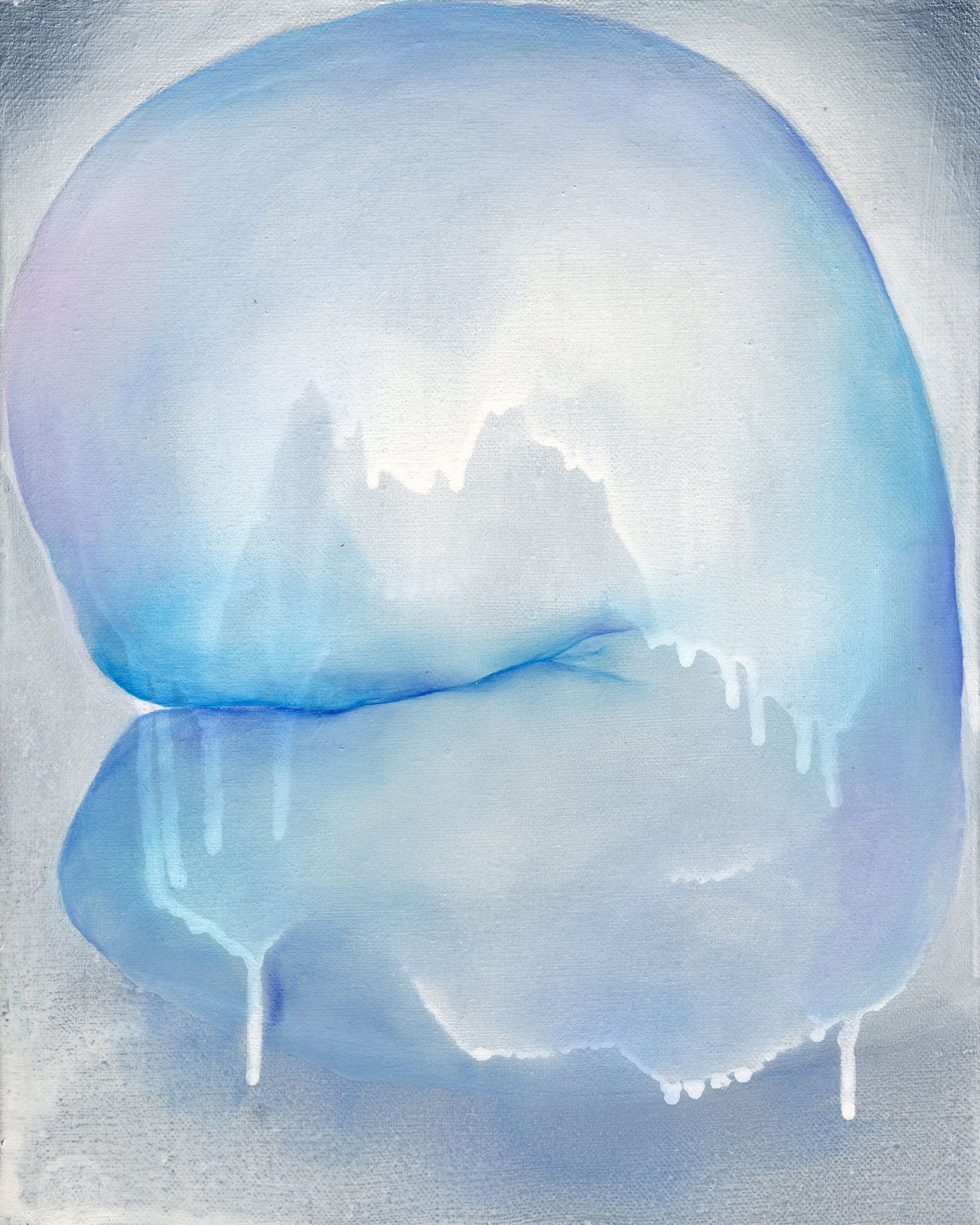
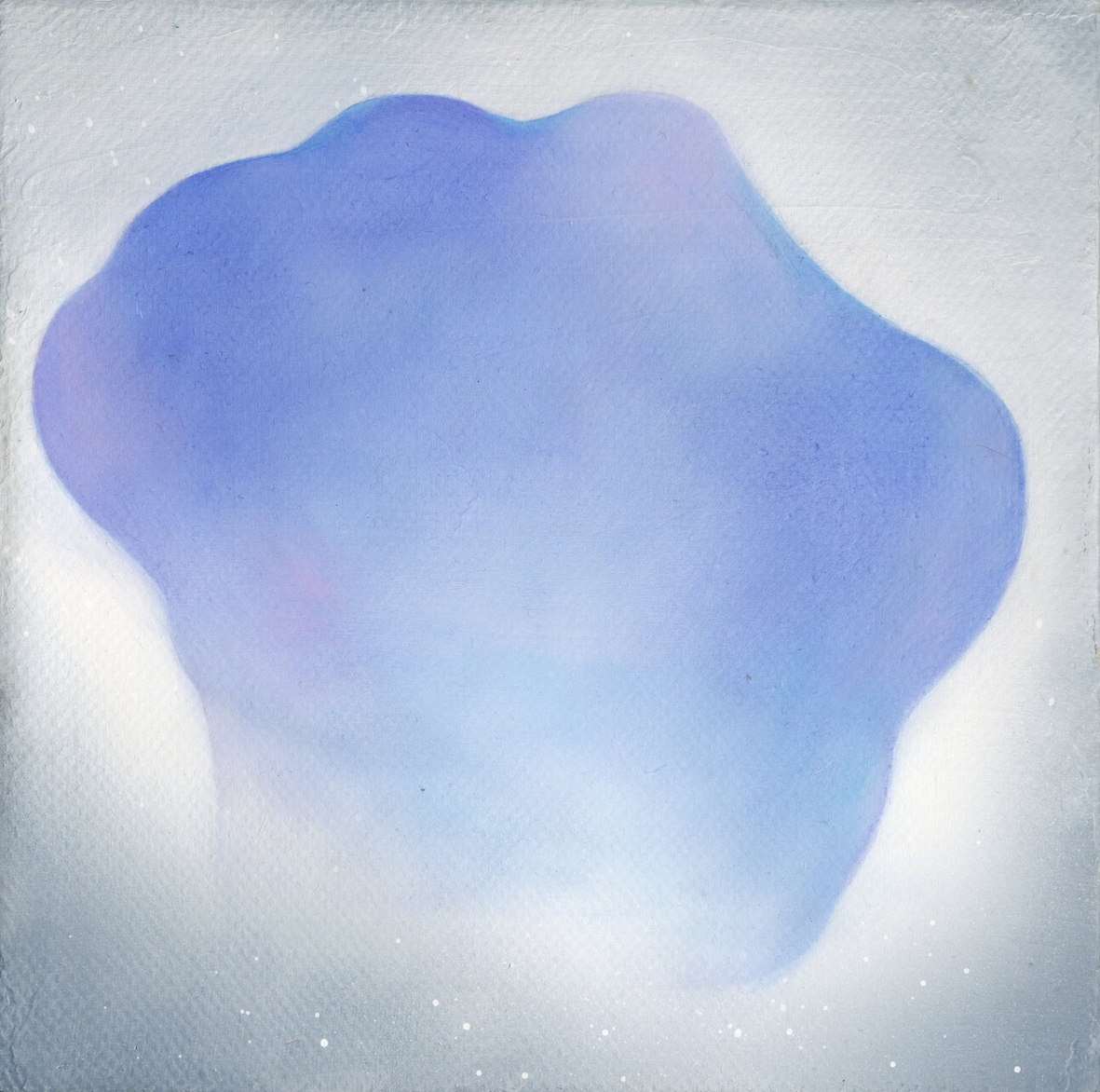
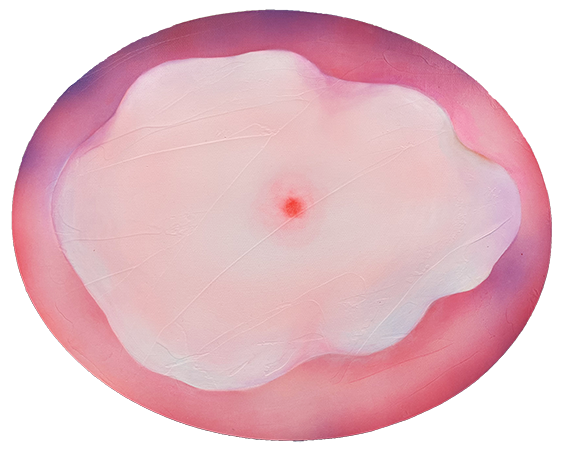
This series embodies a tangible endeavor of abstract expression representing my personal aesthetics and inner perceptions. Within these everyday emotional fragments and introspective dialogues, I seek to extract a visual symbol originating from within myself, reinterpreting it on canvas through the fusion of color and light.
微光系列是我对自己审美与内在感知抽象表达的具体化尝试,我尝试在这些日常的情绪碎片和于自身的交流中,提取一个视觉符号,它从我的身体中来,通过颜色和光的组合重新在画布上。
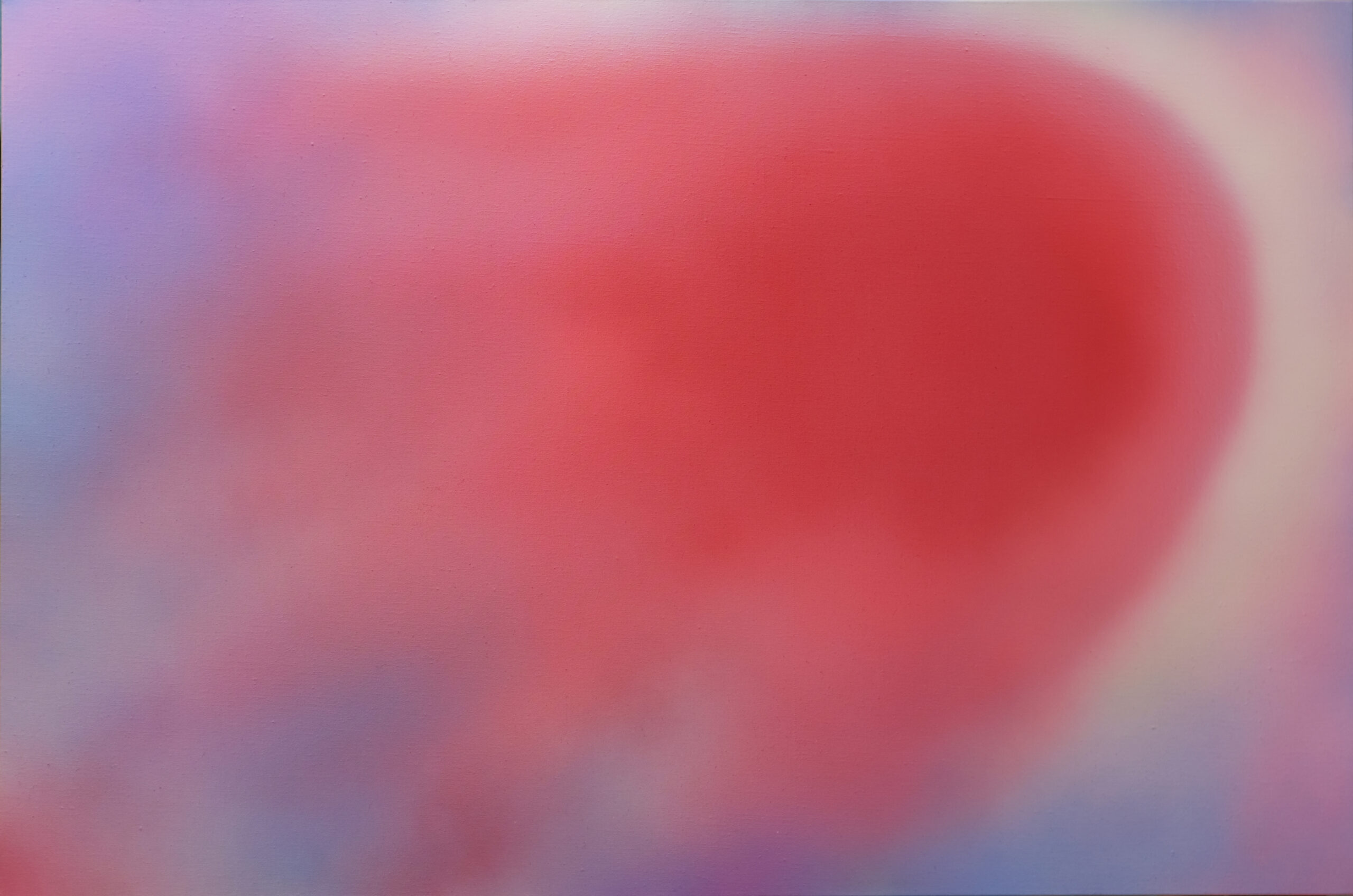
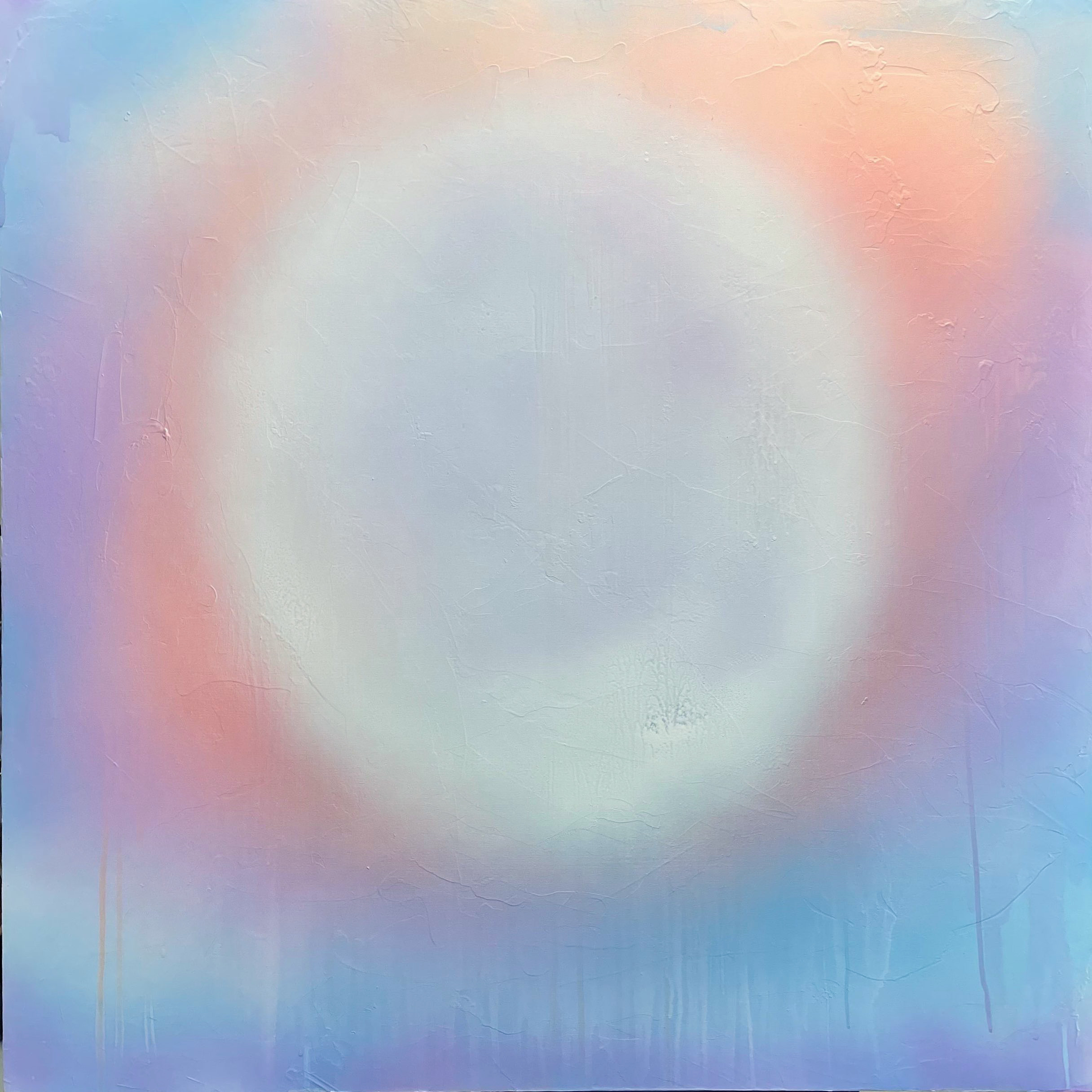
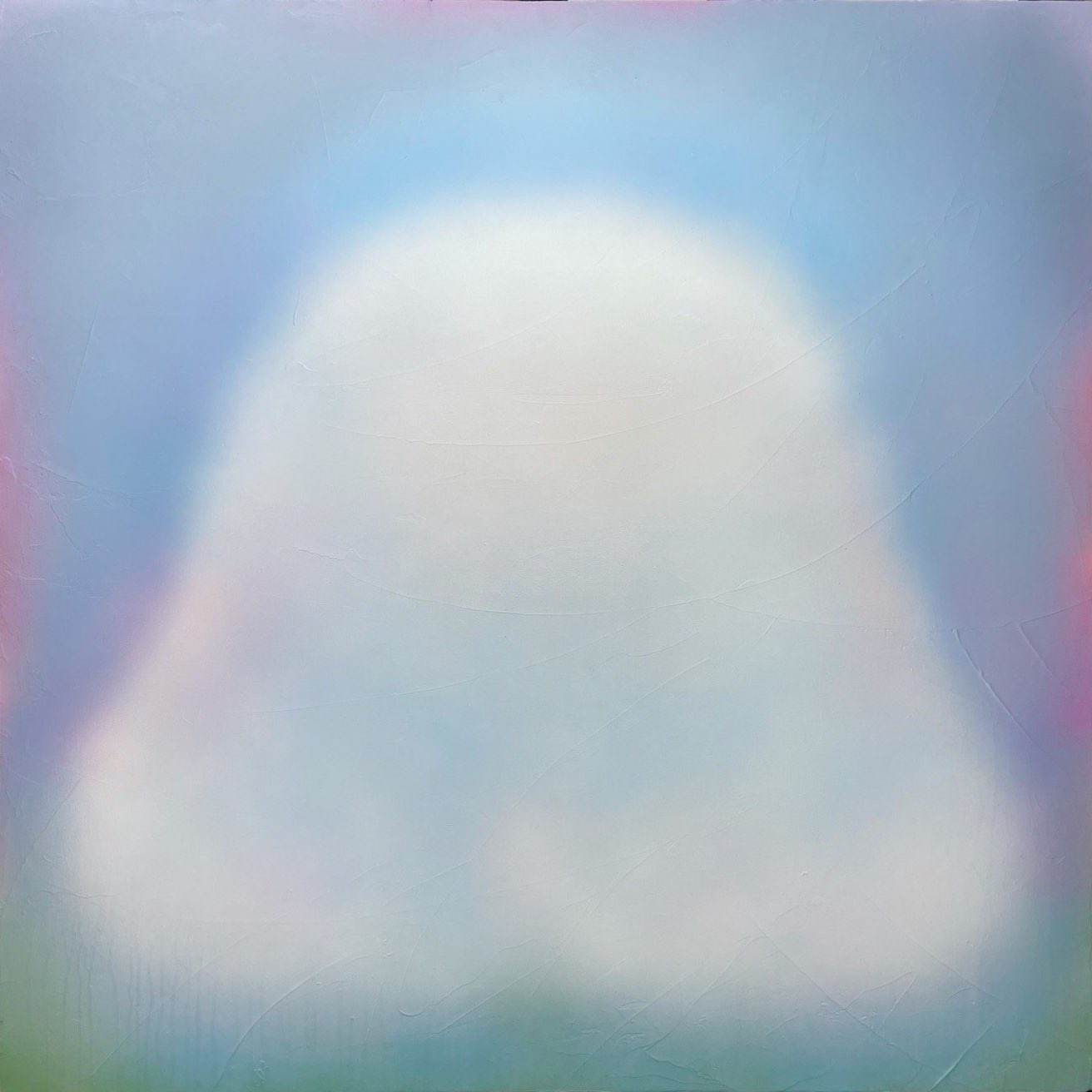
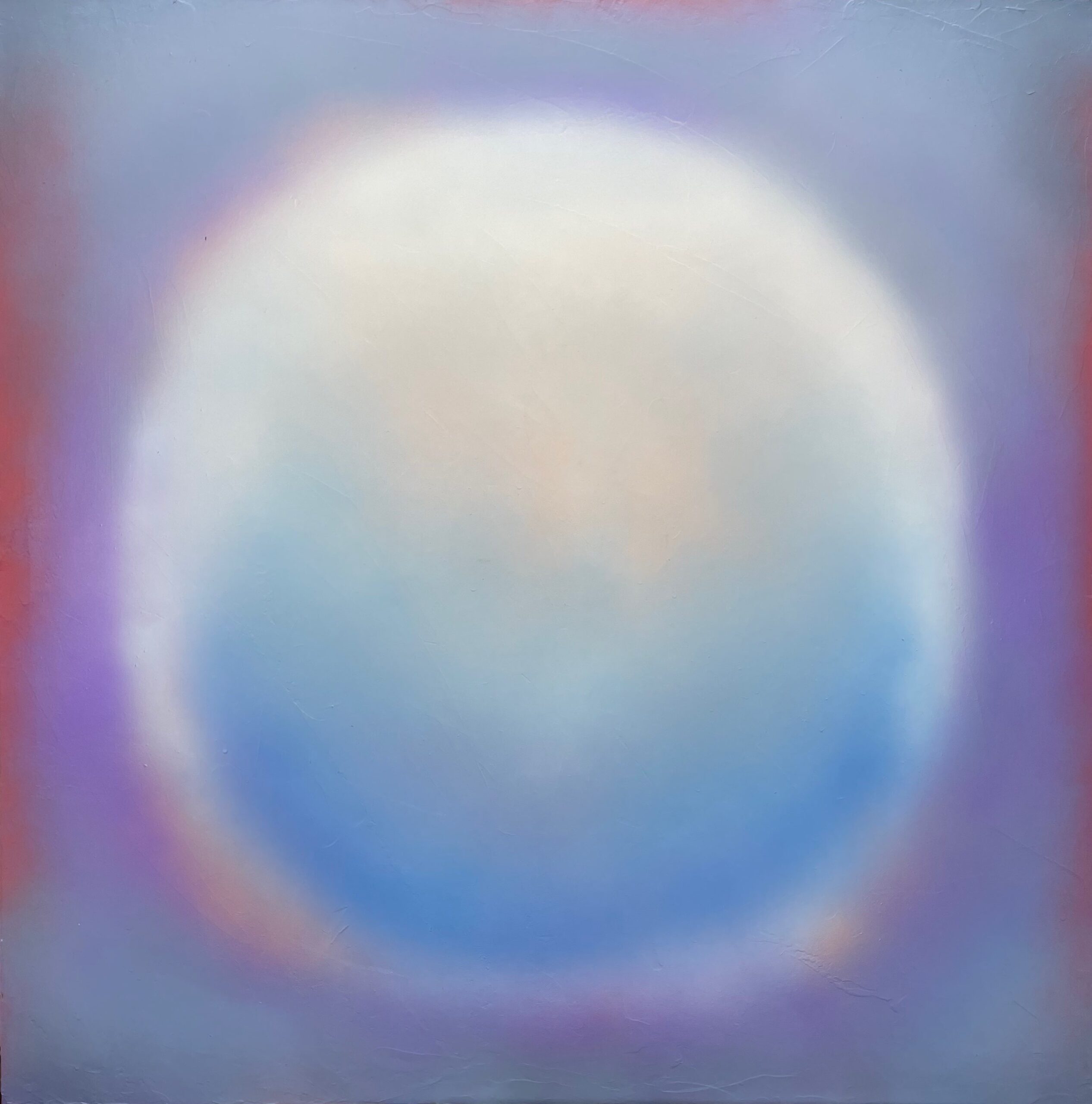
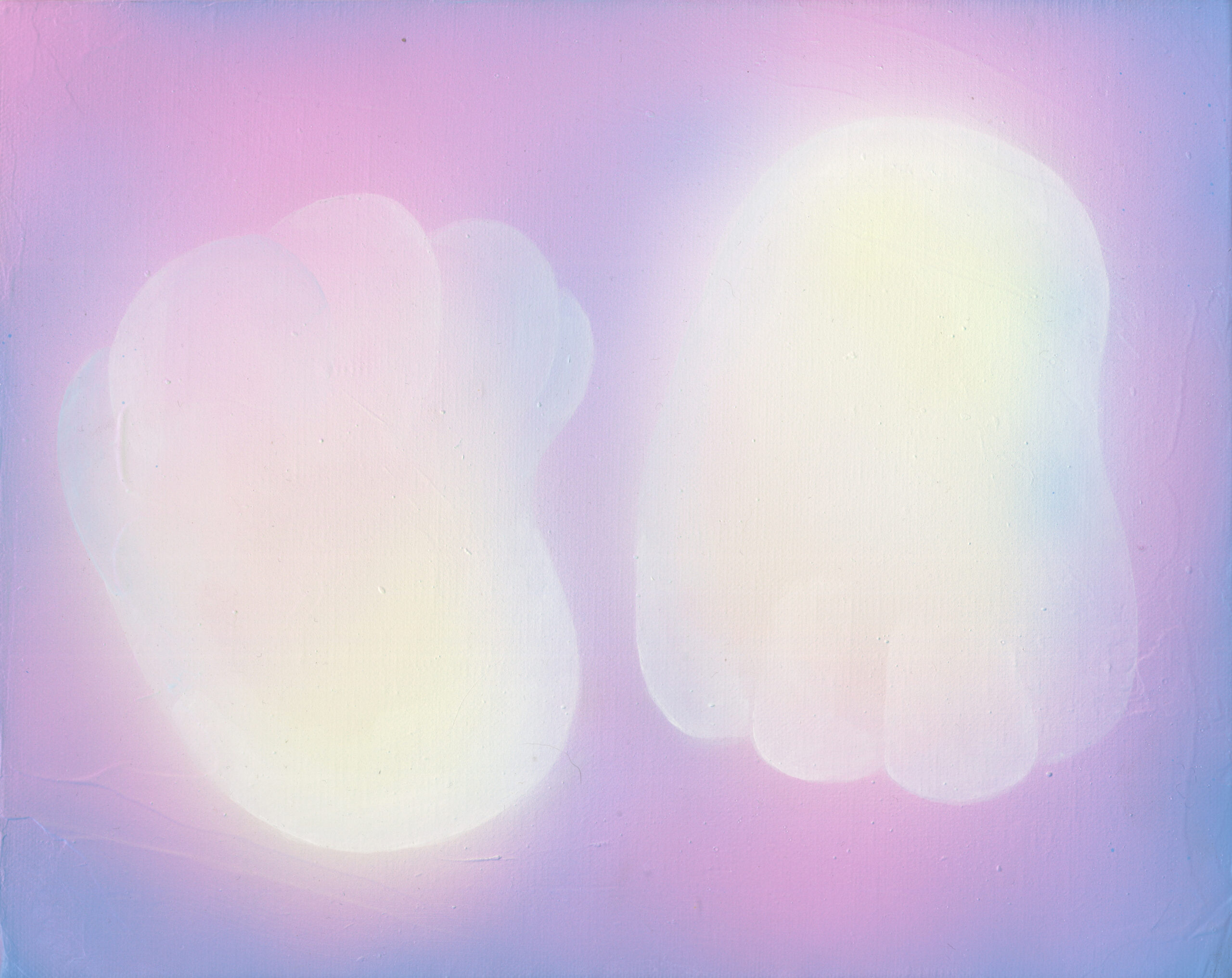
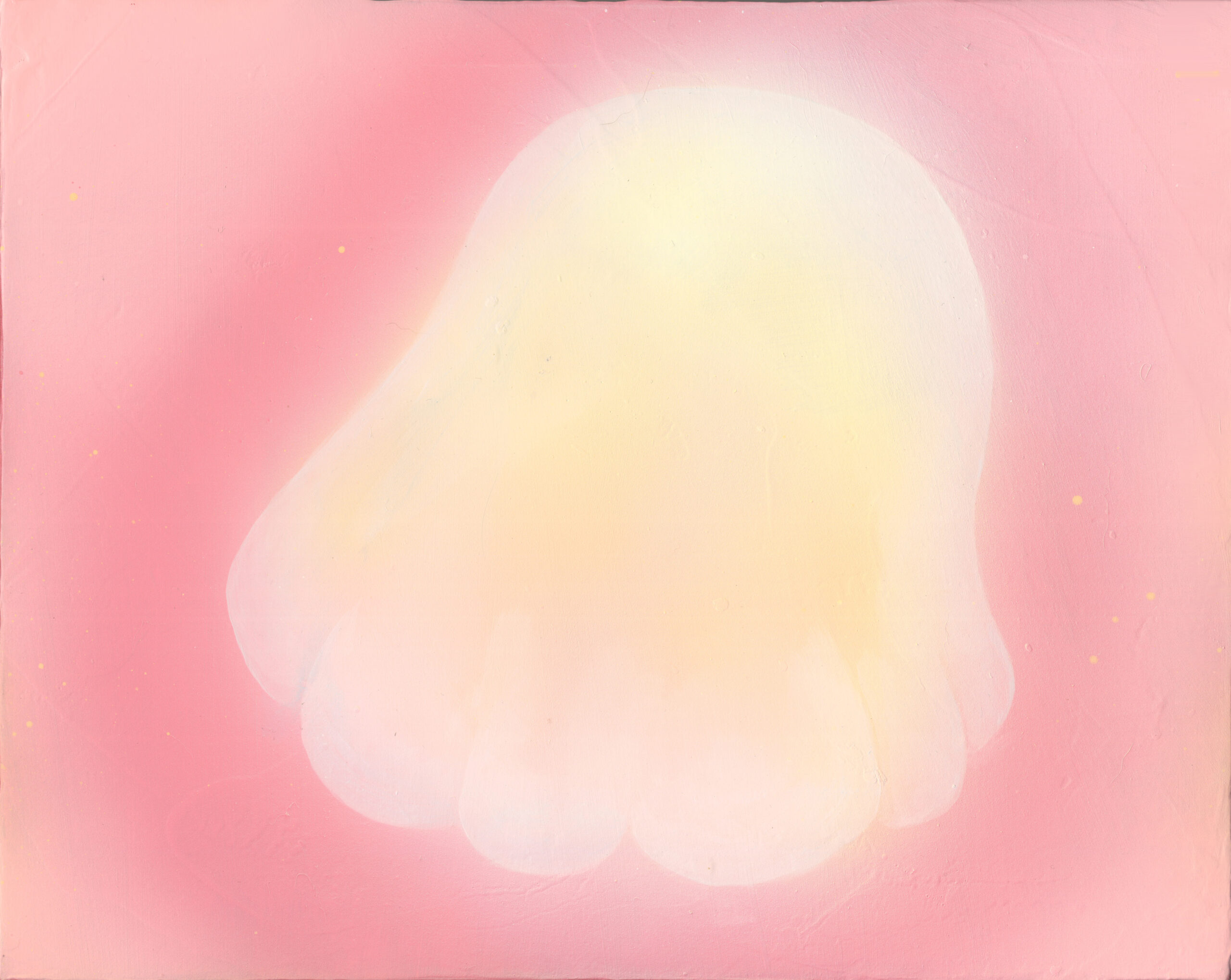
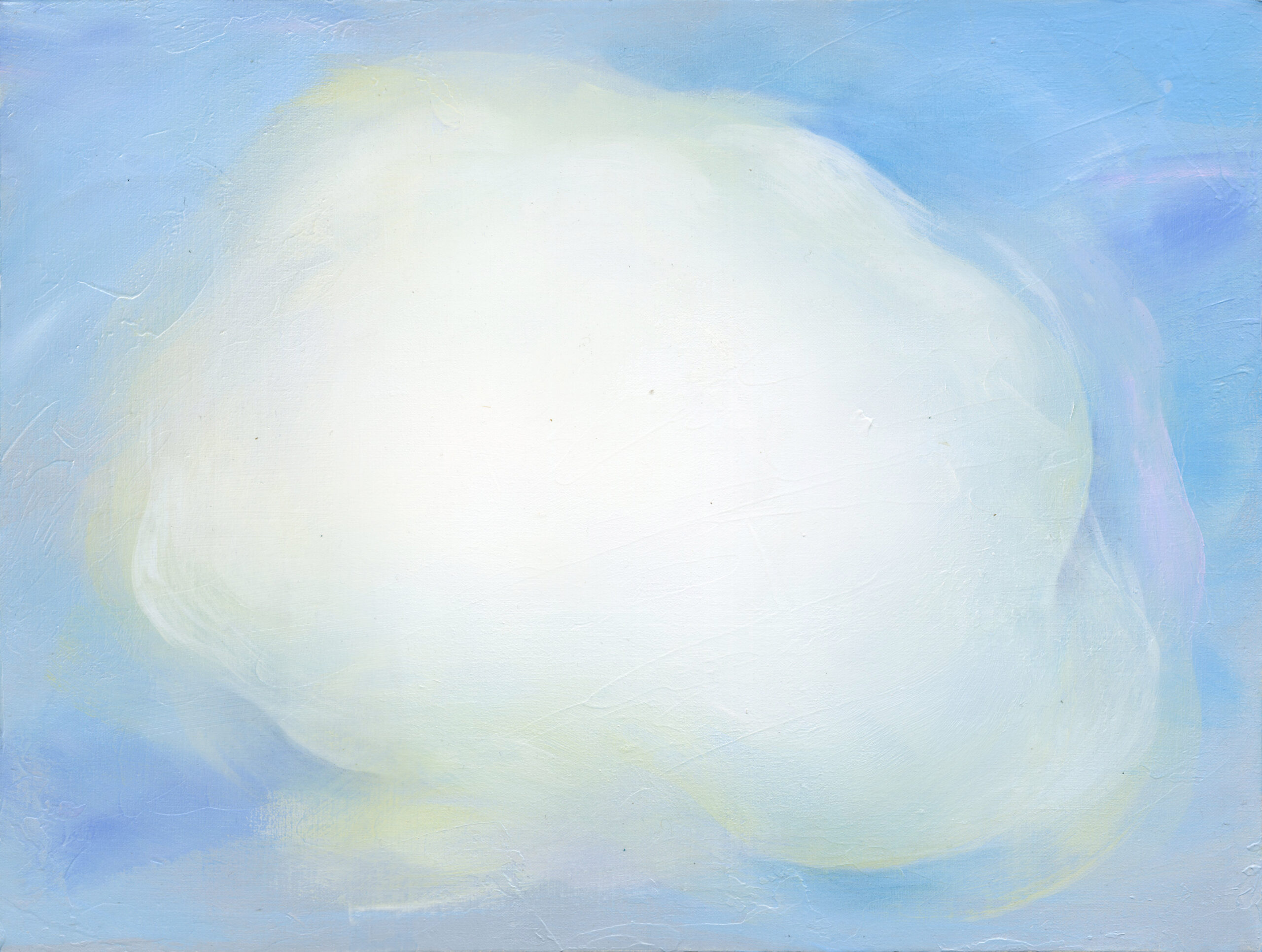
During the creative process, I spend extended periods waiting for the entrance of my emotions. When the entrance appears, I delve into the depths of my subconscious, while my self emerges to observe this abyss and record fleeting imageries. Capturing these imageries requires swiftly transforming the fragmented memories of these imageries into visual forms. It is a moment of instantaneous decision-making where victory or defeat hinges on swift action. If the opportunity passes, I regress into a numb state of suppressed subconsciousness, reverting back to the preparatory phase of squatting, a routine devoid of expressive desires and quite disheartening. In my art-making, I strive to eliminate any possibility of nitpicking, returning painting to the most direct process of reaction-observation-action. Through this process, I unlock myself, break free from constraints, and rediscover the most authentic essence of myself in that fleeting moment.
在创作时,我长时间地蹲守等待自己情绪的入口,当入口出现时,我进入潜意识的深渊,而自我则爬出来观察这个深渊并记录瞬时的意象,而捕捉这个意象需要很快速地将这个意象的记忆碎片转化成图像的形态。这是一个瞬间决定胜负的时刻,若时机一过,我退回到潜意识被压抑的麻木状态,也就退回到蹲守的准备阶段,一种没有表达欲望的令人沮丧的日常状态。在绘制中我试图排除任何咬文嚼字的可能,将绘画回归到最直接的反应–观察–行动的过程上,通过这个过程我打开了自我,摆脱框架,找回那一刻最真实的本我。
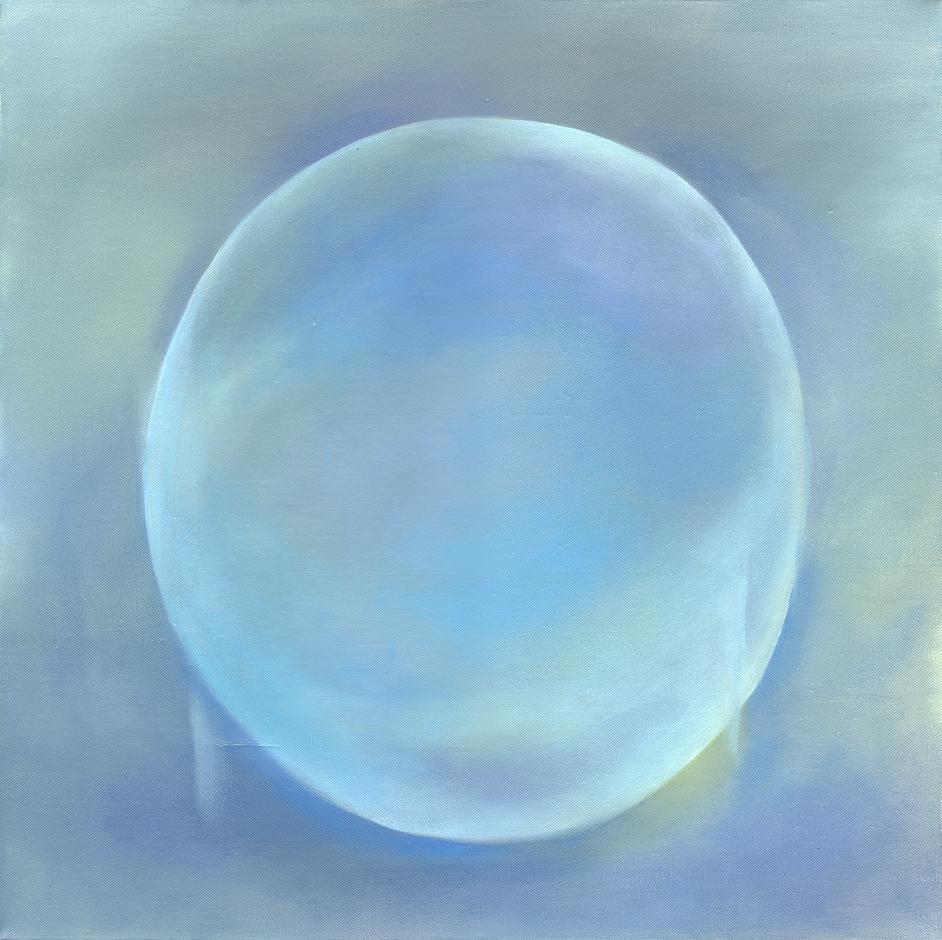
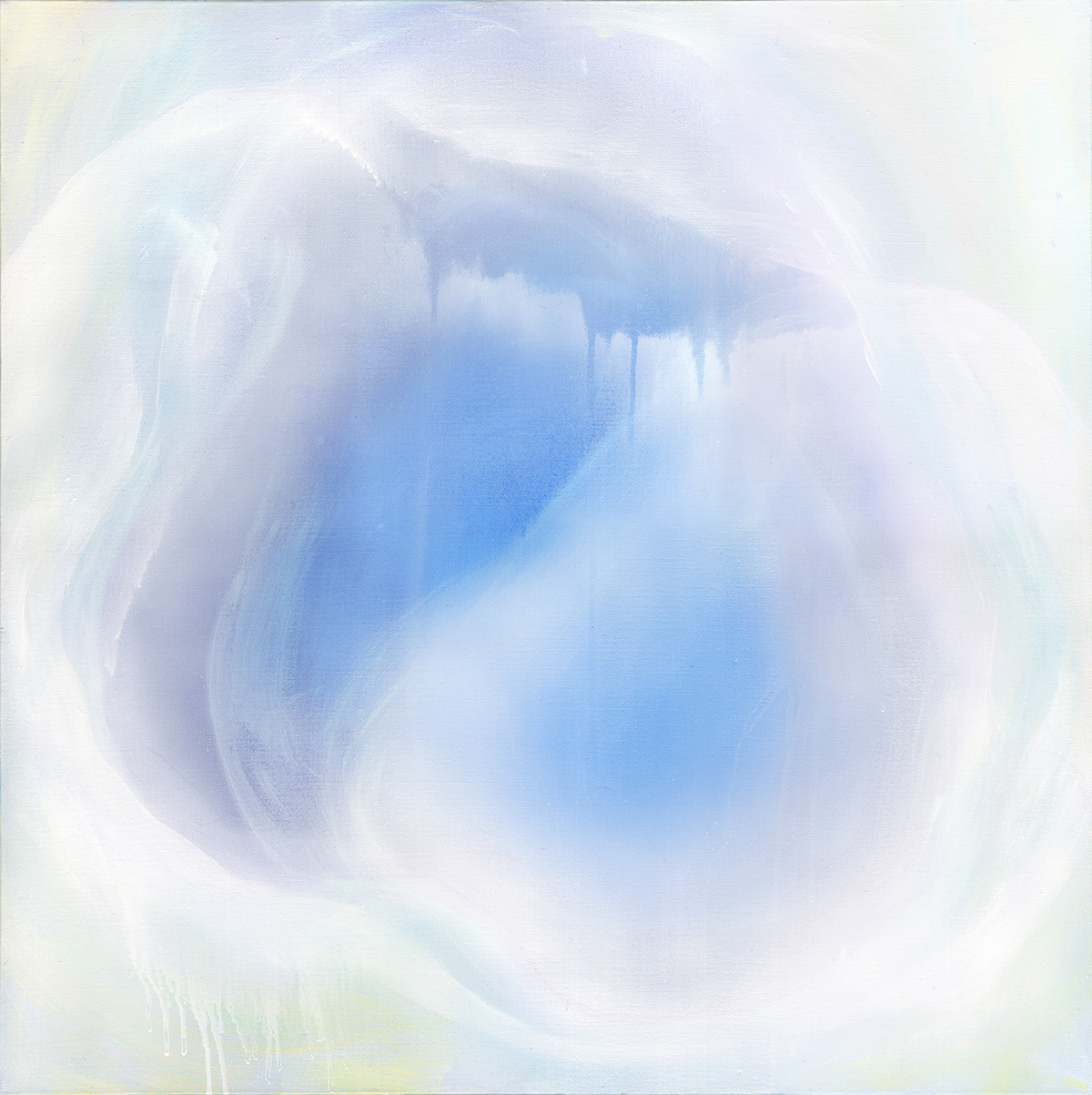
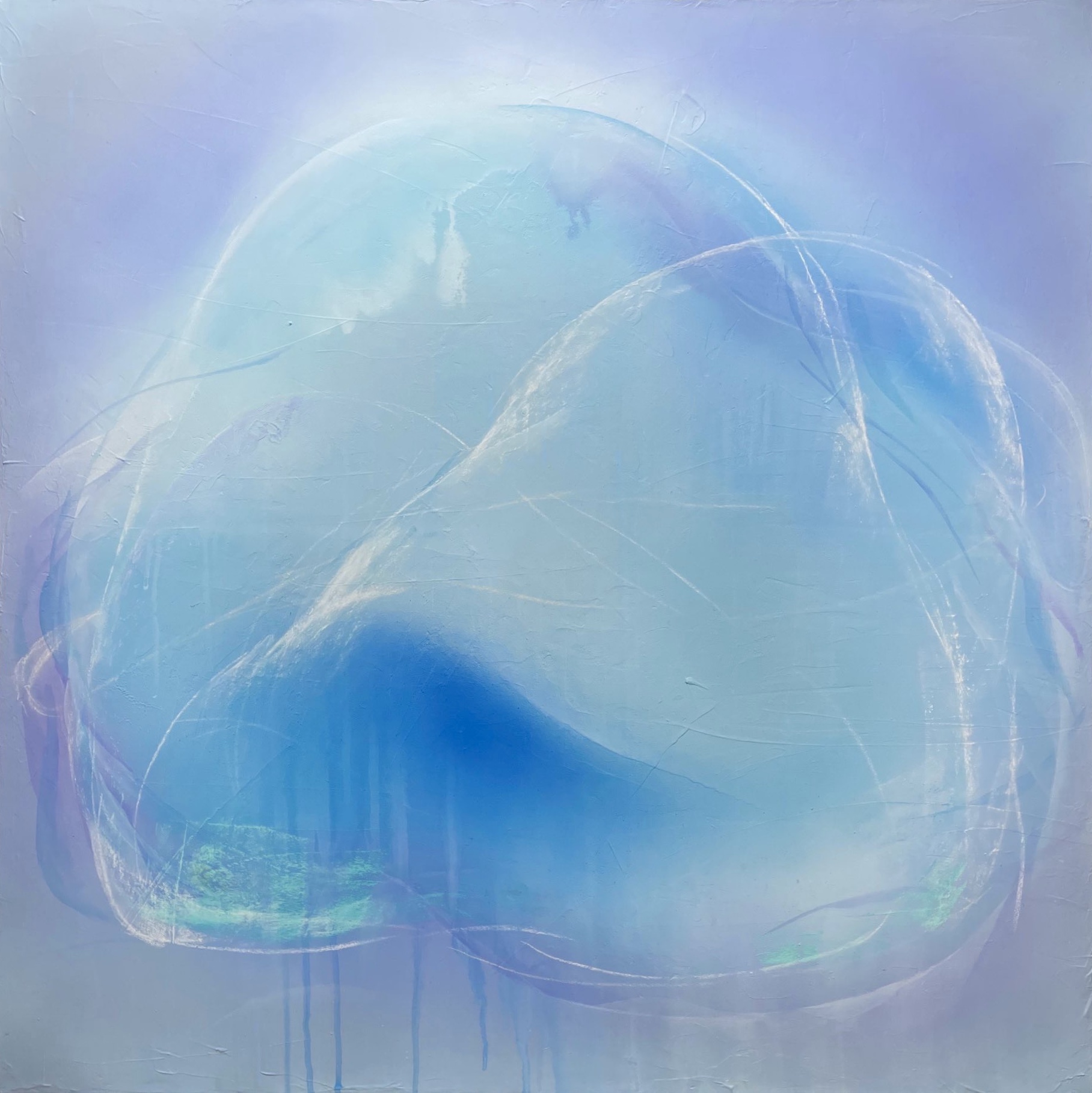
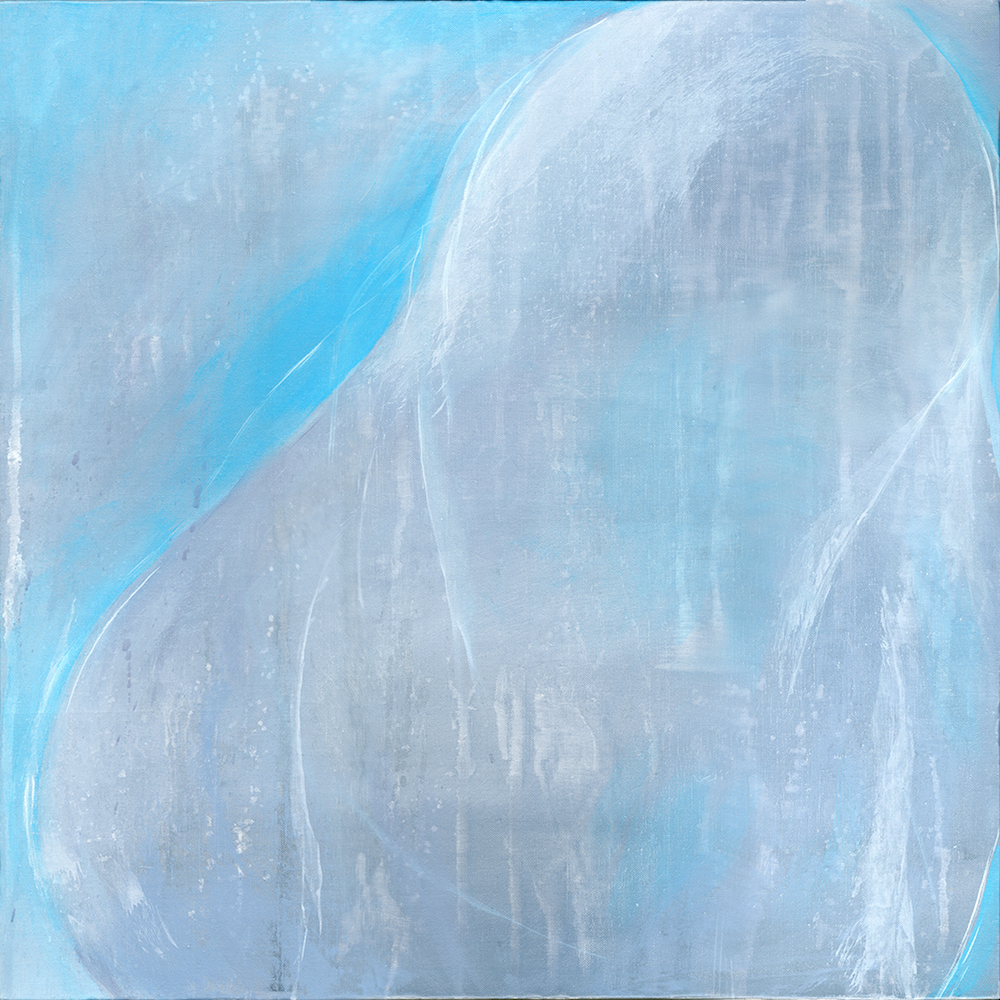
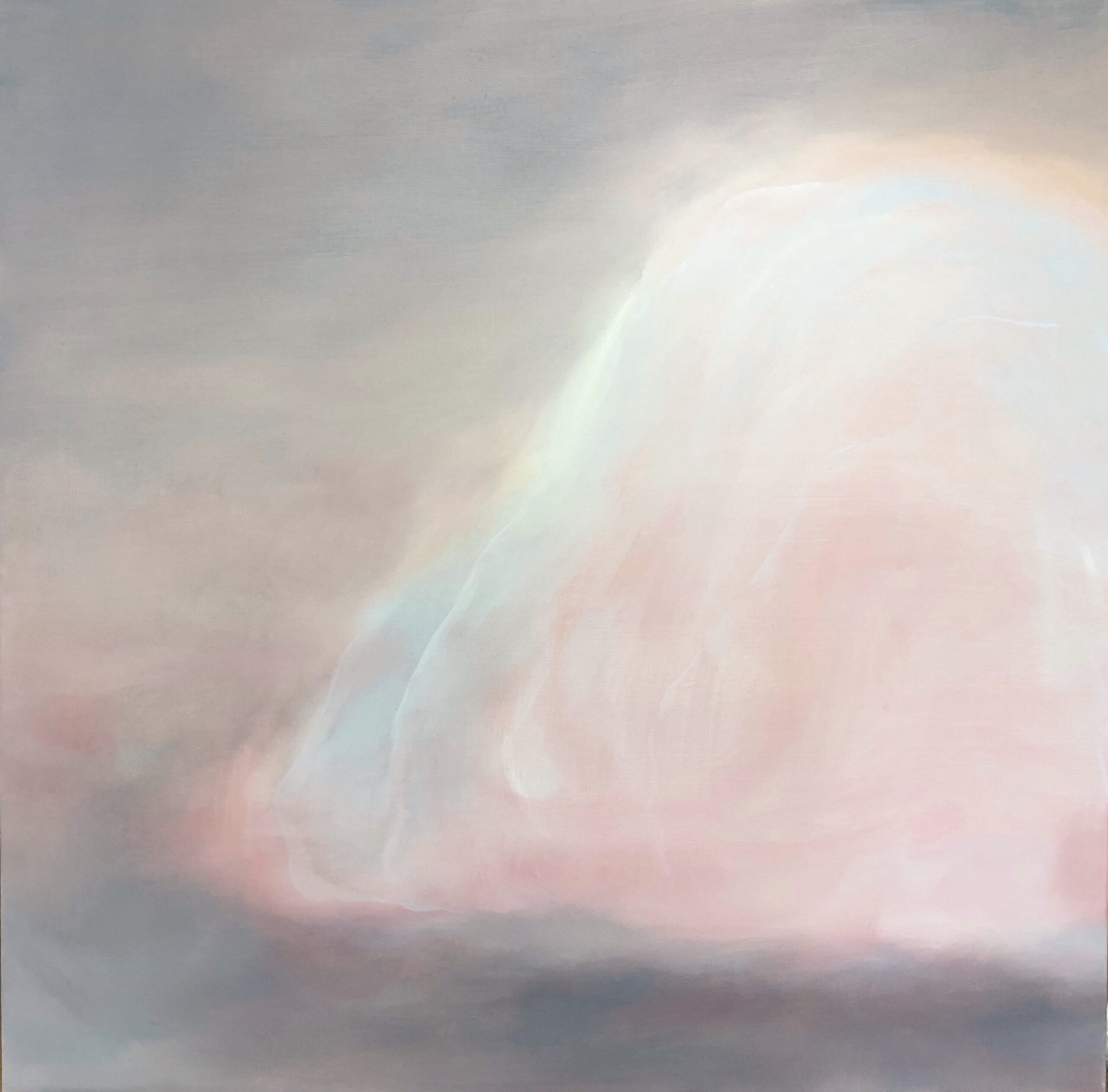
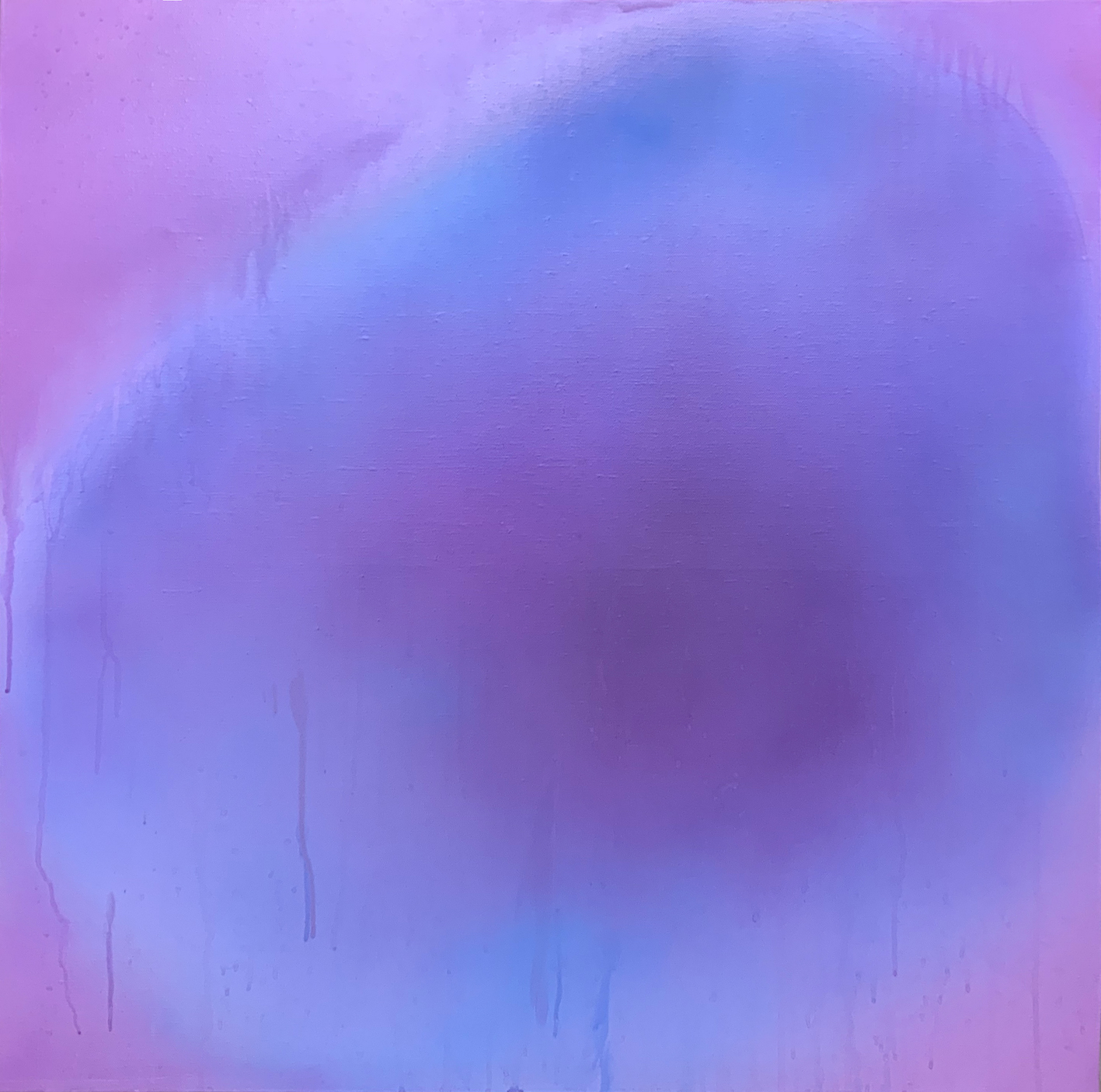
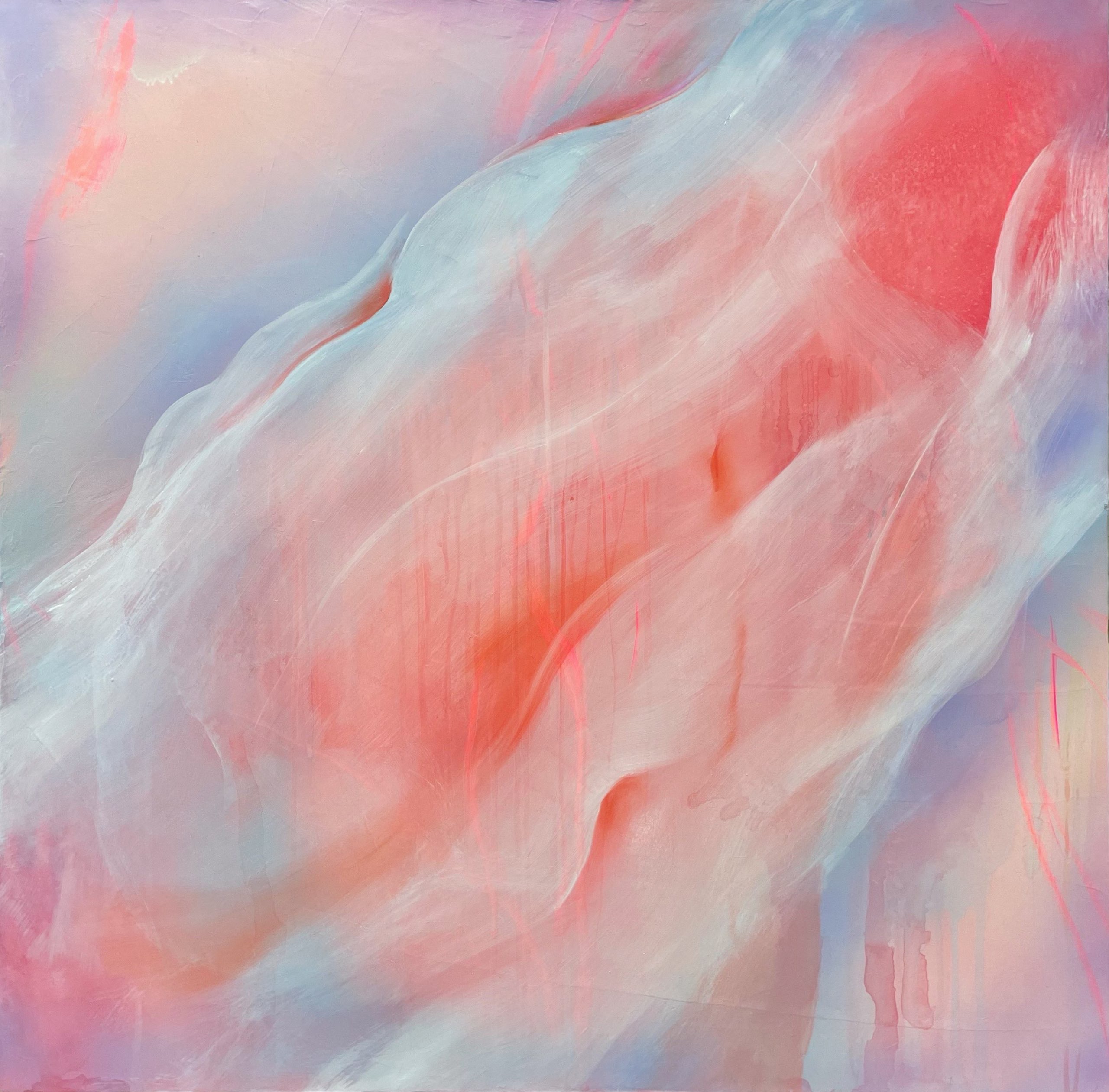
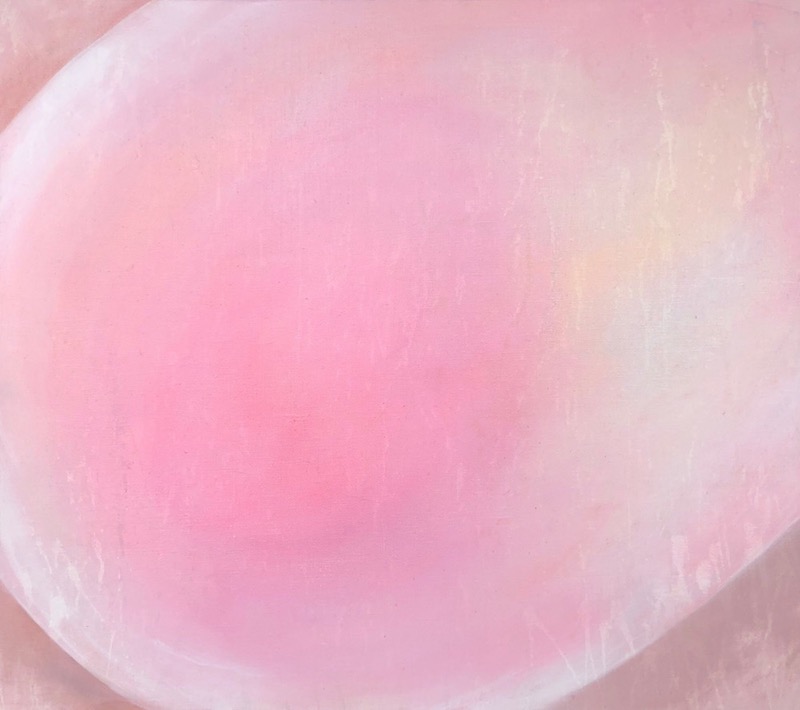
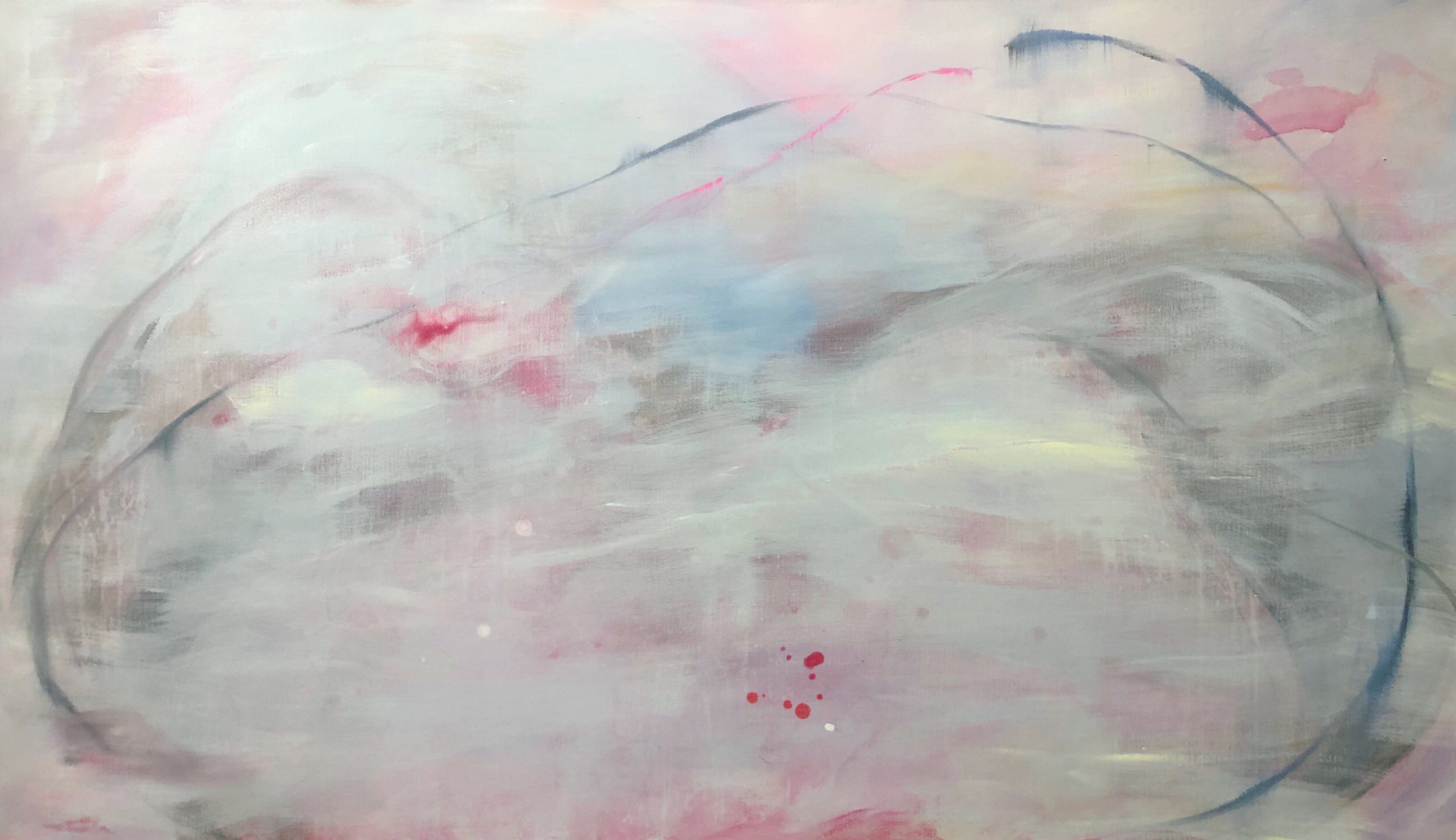
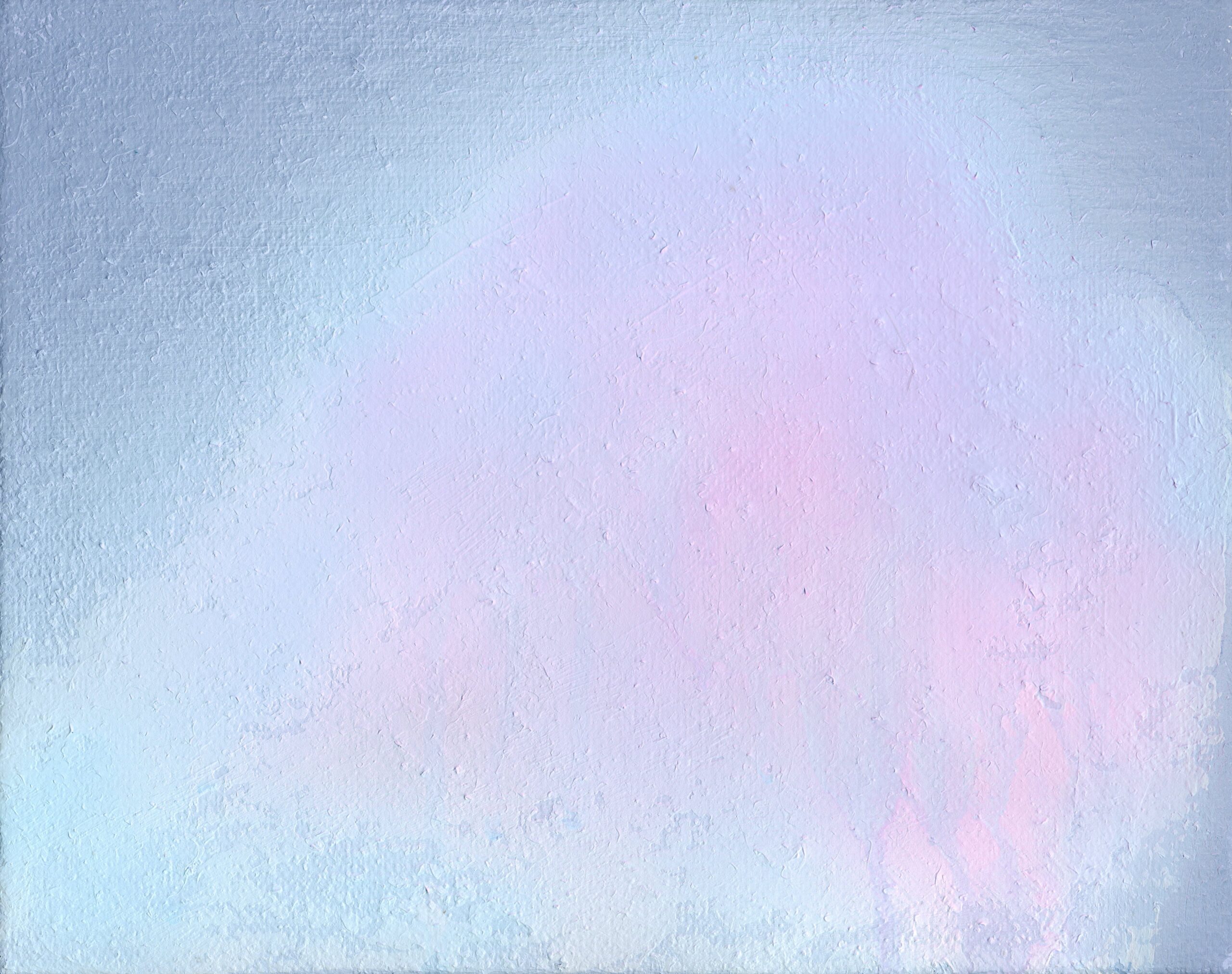
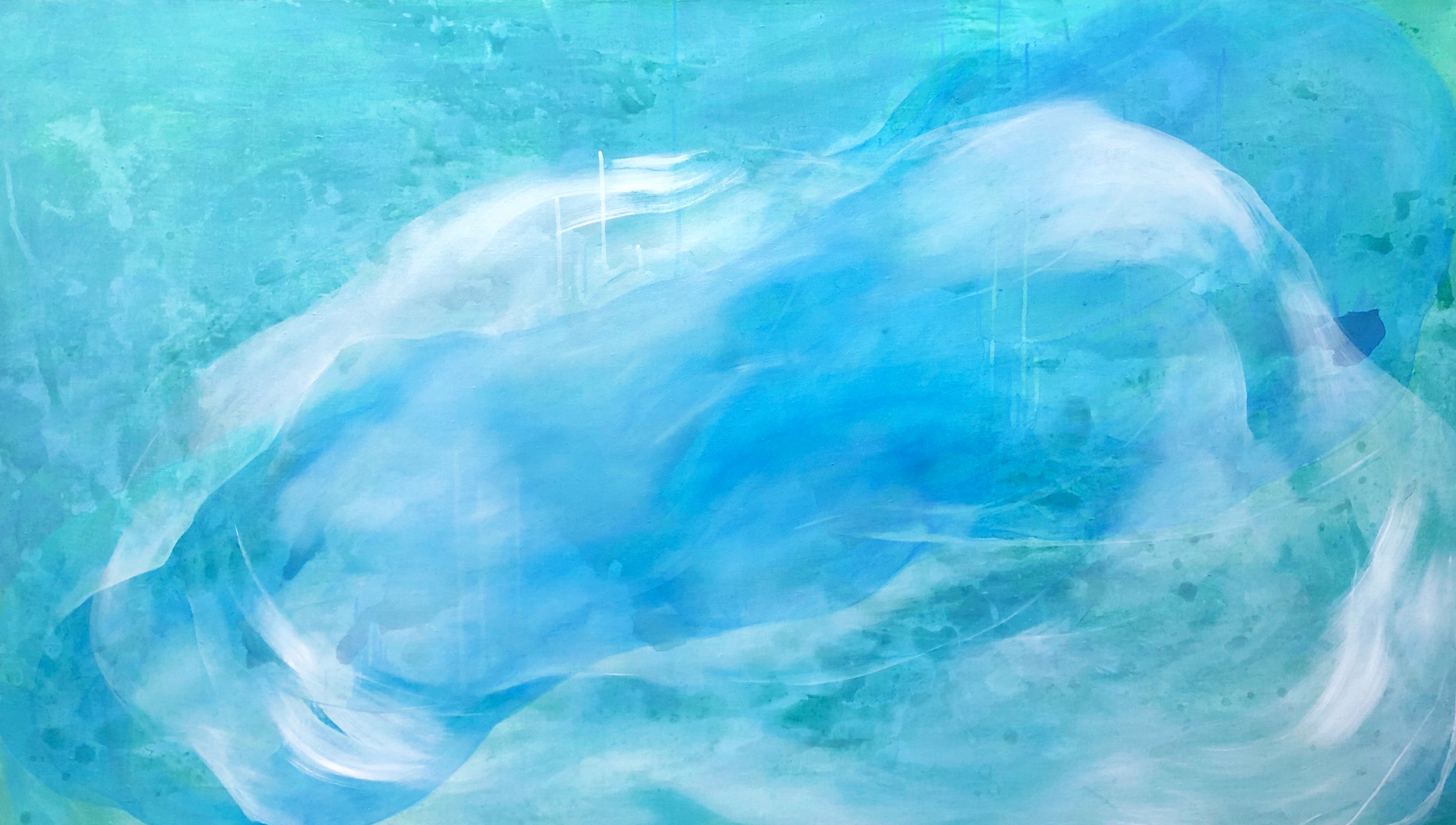
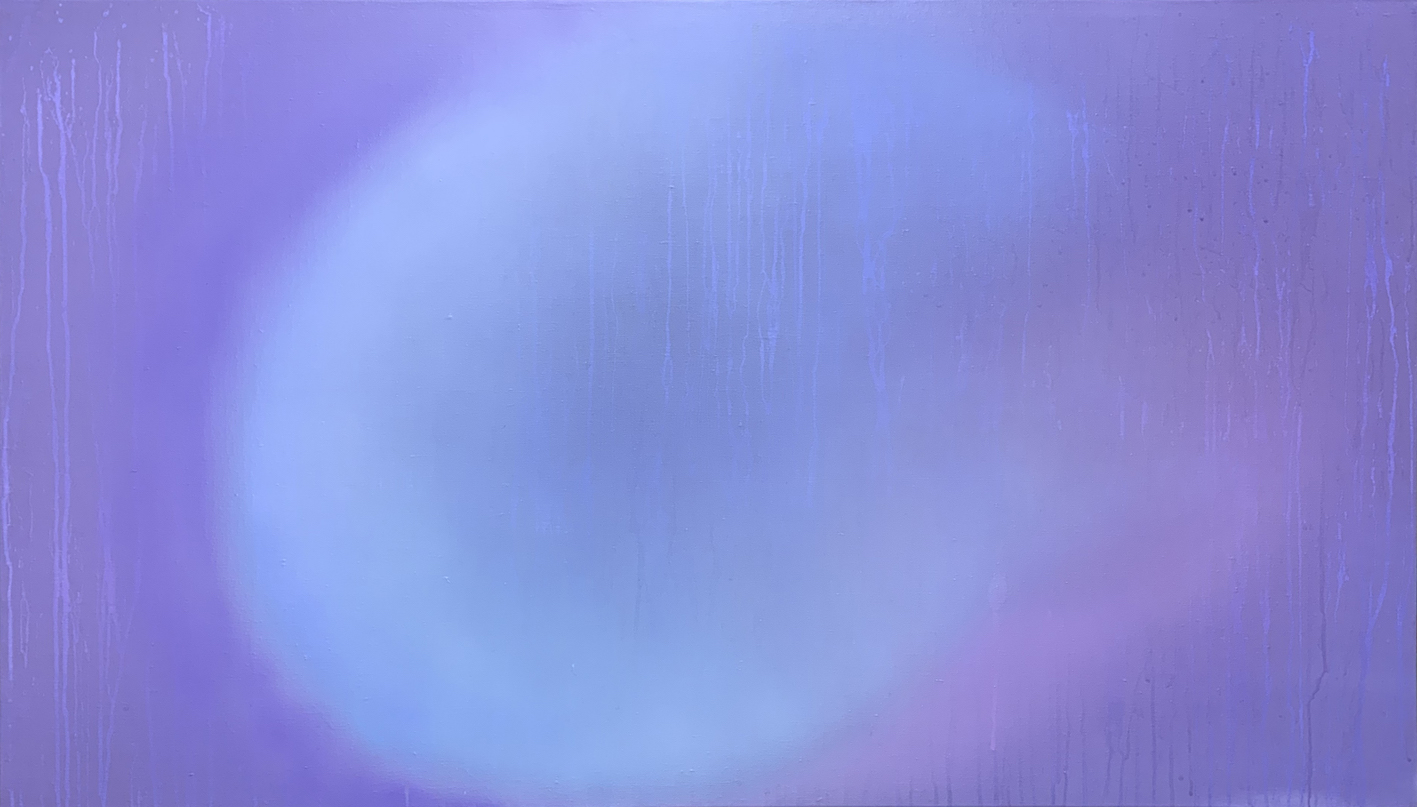
Describing landscapes is my attempt to transpose my inner experiences onto the real world. During this time, I have painted numerous mountains and seas, with a particular fondness for the imagery of islands. The works from this series have subsequently been featured in the cover designs of books centered around island themes.
对风景的描绘是我将自身感受移情到现实世界的尝试,在这个期间,我画了很多的山和海,对岛屿这个意象有很多偏爱,这个系列的作品之后也被用于海岛主题写作的书籍装帧上。